The Great Binary Weight-Loss Journey
I remember the first time I deployed a Prisma-backed API to a Vercel function. I felt like a wizard—until I hit the first cold start. Watching that little loading spinner dance for three seconds while the serverless environment struggled to pull and initialize a massive Rust binary felt like trying to run a marathon while wearing lead boots. We’ve all been there, trading performance for the developer experience (DX) of Prisma’s beautiful DSL. But in 2026, the trade-off isn't just an inconvenience; it’s a bottleneck that modern infrastructure won't tolerate.
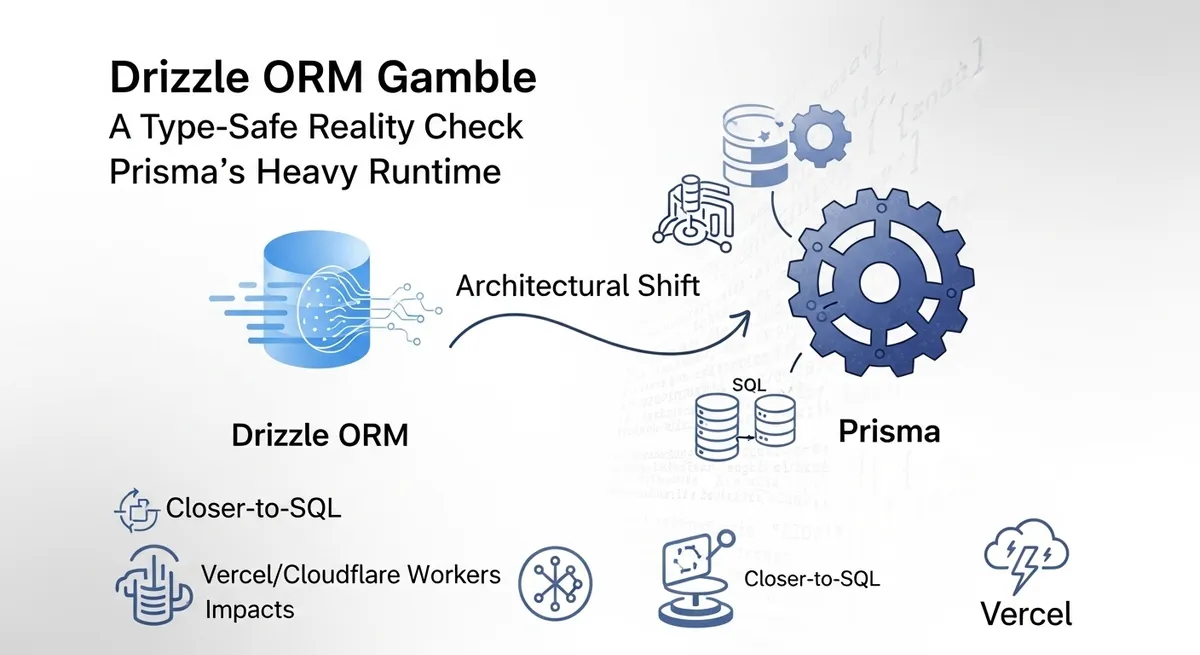
The debate around Drizzle ORM vs Prisma has reached a fever pitch. While Prisma has spent years abstracting away the 'pain' of SQL, Drizzle arrived with a radical, contrarian premise: what if we stopped hiding SQL and started embracing it through the lens of TypeScript? It’s a shift from a heavy-handed framework to a lightweight TypeScript SQL query builder that feels like writing raw SQL, but with the safety net of a thousand guardian angels.
Architecture: The Rust Engine vs. Native TypeScript
For years, Prisma’s secret sauce—and its greatest liability—was its Rust-based query engine. To make your database queries work, Prisma had to ship a platform-specific binary (roughly 14MB) into your deployment. In a world of long-running Docker containers, this was a non-issue. But in the age of Cloudflare Workers and Vercel Edge, that binary was a non-starter. You couldn't even run Prisma on the edge without a middleman like Prisma Accelerate.
Drizzle took a different path. It was built 'edge-native' from day one. There is no binary. There is no background engine. It is a collection of TypeScript files that generate SQL strings. While Prisma 7 recently pivoted to a WASM-based implementation to shrink its footprint to about 1.6MB, Drizzle still sits comfortably in the 33KB–57KB range. When you're fighting for every millisecond of cold start time, that 90% difference in bundle size is the difference between a snappy user experience and a bounce.
Why Cold Starts Matter for Your DevOps Budget
If you're looking at edge-ready ORM performance, you have to look at the tail latency. As noted by Coderfile’s 2026 comparison, Drizzle-based functions consistently start in under 500ms on AWS Lambda, while legacy Prisma versions often drag into the 1.5-second territory. Even with Prisma 7’s improvements, Drizzle remains the king of the 'cold start diet.' If your application scales to zero to save costs, the initialization tax of your ORM is essentially a hidden tax on your user’s patience.
The DSL Dilemma: Learning a Language vs. Mastering a Tool
Prisma asks you to learn schema.prisma. It’s a beautiful, human-readable language, but it’s another abstraction layer between you and the database. When things go wrong, or when you need a complex LATERAL JOIN, you find yourself fighting the abstraction. You end up using $queryRaw, at which point you’ve lost all the benefits of the ORM anyway.
Drizzle’s philosophy is 'SQL-first.' If you know SQL, you already know Drizzle. It uses TypeScript-native functions that mirror standard SQL syntax. Drizzle ORM vs Prisma isn't just about speed; it's about control. In Drizzle, you define your schema in standard .ts files. There is no prisma generate step. There is no hidden code-gen magic that can get out of sync with your types. Your types are inferred directly from your code. When you change a column name, your TypeScript compiler screams at you instantly—no extra CLI commands required.
Migrations: Automated Magic vs. Transparent Control
Prisma Migrations are legendary for their ease of use. You change your schema, run a command, and Prisma handles the rest. But for many DevOps engineers, this 'black box' approach is terrifying. Drizzle Kit, the migration utility for Drizzle, takes a different approach. It compares your TypeScript schema to your database and generates standard SQL files.
This allows for a 'human-in-the-loop' workflow. You can inspect the SQL, modify it to include a specific index or a data migration script, and then commit it to version control. It feels more like the traditional migration tools we’ve used for decades, but with the added benefit of being perfectly synced with our TypeScript definitions. As highlighted in a recent Production Engineer's comparison, this transparency is why many enterprise teams are making the jump; they want to know exactly what is happening to their production tables.
The Performance Gap: 2x or 5x?
In simple CRUD operations, Drizzle typically outperforms Prisma by a factor of two to five. This isn't because Prisma is poorly written; it's because Prisma has more work to do. Even with the WASM engine, Prisma has to translate its internal query representation into something the database understands. Drizzle, being a TypeScript SQL query builder, effectively just concatenates strings with type safety. There is zero intermediate engine layer. In high-traffic environments, those saved CPU cycles translate directly into lower infrastructure bills and higher throughput.
Is Prisma Obsolete? (The Nuance)
With all this praise for Drizzle, is it time to delete your Prisma folders? Not necessarily. Prisma still holds the crown for visual tooling. Prisma Studio is a world-class database GUI that Drizzle’s 'Drizzle Studio' is still chasing. Furthermore, for junior developers, Prisma’s abstraction is a safety blanket. It prevents you from making classic SQL mistakes and provides a very high-level API that is incredibly easy to reason about.
However, for the senior developer or the architect building for the edge, the 'SQL knowledge barrier' is a feature, not a bug. Understanding your database is part of the job. Drizzle rewards that knowledge with extreme performance and a type system that feels like it’s actually working with you rather than for you.
Final Verdict: Should You Switch?
The Drizzle ORM vs Prisma debate ultimately comes down to your environment. If you are building a traditional monolith on a VPS or a long-running container, Prisma 7’s improved WASM engine might be 'good enough.' But if you are building on the edge, using serverless functions, or simply want the smallest possible footprint with the most control over your SQL, Drizzle is the clear winner.
Drizzle has officially moved from being the 'scrappy underdog' to the default recommendation for modern stacks like the T3 Stack. It’s no longer a gamble—it’s a calculated move toward a more performant, transparent, and type-safe future. Your SQL queries deserve to be more than just a string in a black box; they deserve a reality check. Give Drizzle a shot on your next microservice, and you’ll likely find it hard to go back to the weight of a heavy engine.
What’s your take? Have you felt the performance boost after migrating, or do you find the Drizzle syntax too verbose compared to Prisma’s clean API? Let's discuss in the comments below.