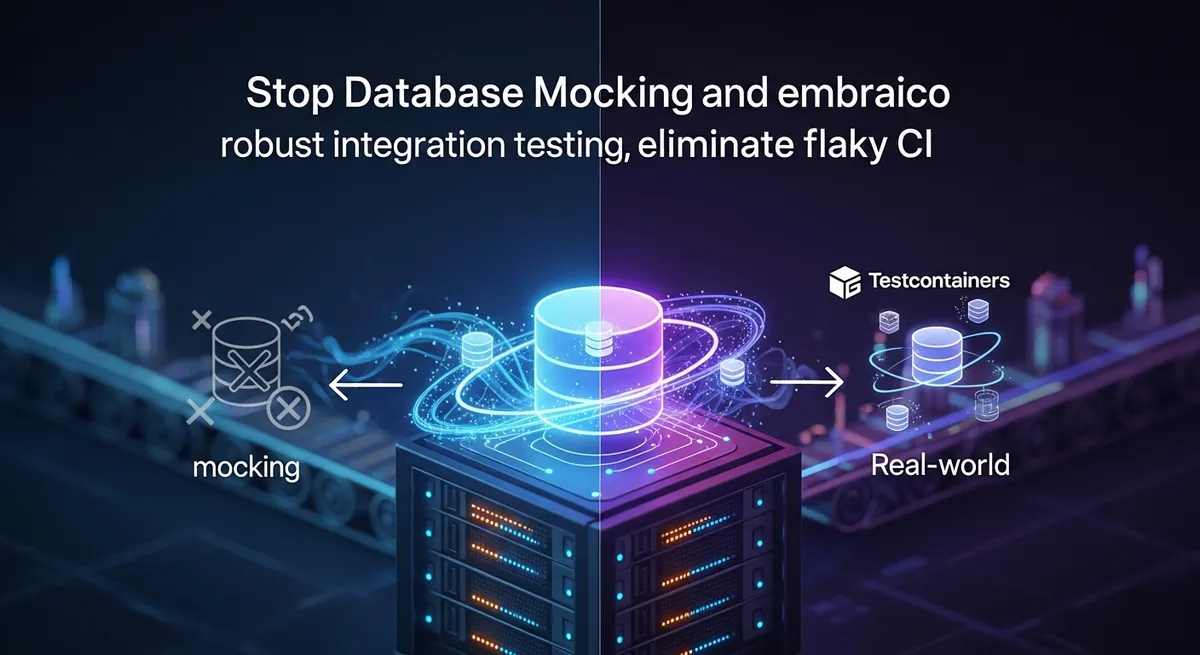
The Great Mocking Lie
We have all been there. It is 6:00 PM on a Friday, and the CI pipeline is a sea of green. You push your latest feature—a complex search query using PostgreSQL window functions and a JSONB filter—confident that your H2 in-memory database tests have verified everything. Ten minutes later, PagerDuty is screaming. Production is throwing Syntax Error at or near \"OVER\". Why? Because while your mock was happy, real Postgres had different ideas about SQL dialects.
For years, we traded accuracy for speed. We used H2, SQLite, or brittle Mockito-style interface mocks because spinning up a real database was 'too slow' or 'too hard.' But in an era where Testcontainers database integration testing has become the industry standard, continuing to mock your database isn't just an old habit; it is a technical liability. If your test suite doesn't speak the same language as your production environment, you aren't actually testing your code—you are testing a fantasy version of it.
The Quiet Betrayal of In-Memory Mocks
Mocks are convenient liars. They tell you what you want to hear so you can finish your sprint tasks. When you swap a production Postgres instance for an in-memory substitute like H2, you are opting into a world of subtle, dangerous discrepancies. According to research on Spring Boot Testcontainers, even basic features like LIMIT/OFFSET logic, constraint semantics, and collation rules vary enough between engines to cause false positives.
Think about the features that make Postgres great: JSONB, Common Table Expressions (CTEs), and advanced concurrency locks. These are not just 'extra' features; they are foundational to how modern backend services operate. An in-memory mock cannot simulate a GIN index or verify if your query will actually hit an index or fall back to a full table scan. When you rely on mocks, you are performing 'integration theater'—the act of running tests that feel productive but fail to catch the most critical class of bugs: the ones that happen at the boundary of your application and its data.
Why Complexity Requires Reality
The rise of AI-driven applications has only widened the gap. If you are using pgvector for vector similarity searches, how do you mock that? You can't. You need the actual Postgres engine to verify HNSW index performance and distance operator accuracy. As highlighted in the Integration Tests in the Testcontainers Era report, mocks simply cannot verify foreign key constraints or transaction atomicity. If your test passes because the mock doesn't enforce a NOT NULL constraint that exists in production, your test is worse than useless—it is providing false confidence.
Enter the Era of Disposable Infrastructure
The game changed when Testcontainers database integration testing went mainstream. By leveraging Docker, Testcontainers allows you to spin up a real, version-matched instance of Postgres (or Kafka, Redis, and beyond) directly from your JUnit or Go test code. It manages the entire lifecycle: pulling the image, starting the container, waiting for the port to be ready, and—crucially—cleaning it up via the 'Ryuk' sidecar container when the process finishes.
With the 2025 Docker State of Application Development Report showing container adoption at a staggering 92%, the friction of using Postgres Docker containers testing has effectively vanished. We are no longer limited by the 'it works on my machine' syndrome because the container running on your local laptop is identical to the one in your GitHub Actions runner and identical to the one in your production Kubernetes cluster.
Modern Tooling: No More Excuses
One of the strongest arguments against integration testing used to be the 'boilerplate' cost. Setting up Docker Compose files, managing ports, and handling database migrations manually was a headache. However, modern frameworks have internalized the Testcontainers philosophy.
- Spring Boot 3.1+: Introduced
@ServiceConnection, which automatically discovers the connection details of a Testcontainers-managed database and injects them into your application context. No more manualDynamicPropertySourceconfiguration. - AtomicJar (Docker) Integration: Since Docker acquired the team behind Testcontainers, the integration has become even tighter, moving from a niche library to a core pillar of the DevOps lifecycle.
- Reusable Containers: You can now keep containers running between test executions during local development, slashing the 'inner loop' feedback time to nearly the speed of a unit test.
Addressing the Speed vs. Fidelity Debate
I hear the counter-argument often: \"But my unit tests take 500ms and Testcontainers takes 5 seconds!\". This is a valid concern for pure TDD enthusiasts. The solution isn't to go back to mocks; it is to be smarter about your testing pyramid. Use pure unit tests for your domain logic and business rules—the code that doesn't touch a database. But the moment you write a Repository, a DAO, or a Service that persists data, you must use Testcontainers database integration testing.
If resource intensity is an issue—say, your local machine gasps for air when running Postgres, Kafka, and Redis simultaneously—consider Testcontainers Cloud. Offloading the container execution to a remote cloud while keeping the test logic local is a game-changer for reliable CI/CD pipelines, especially for teams working on underpowered hardware or within constrained CI runners.
The Death of 'Integration Theater'
We need to stop treating integration tests as a secondary luxury. In a world of microservices and complex data types, the 'integration' is the most dangerous part of your system. Using Postgres Docker containers testing ensures that your SQL syntax is valid, your migrations actually run against the target version, and your transaction boundaries behave as expected.
By adopting Testcontainers database integration testing, you are making a commitment to reality. You are deciding that catching a bug at 2:00 PM during a build is infinitely better than catching it at 2:00 AM during an incident response call. It is time to retire the H2 config files, delete the brittle repository mocks, and start testing against the real thing. Your production environment—and your sleep schedule—will thank you.
Take Action Today
Ready to level up? Start by identifying one repository test that currently uses a mock or H2. Swap it out for a Testcontainers implementation. Observe how many 'hidden' bugs—like improper sequence handling or missing extensions—suddenly come to light. Once you see the truth, you'll never want to go back to the lie.