The 3:00 AM PagerDuty Nightmare
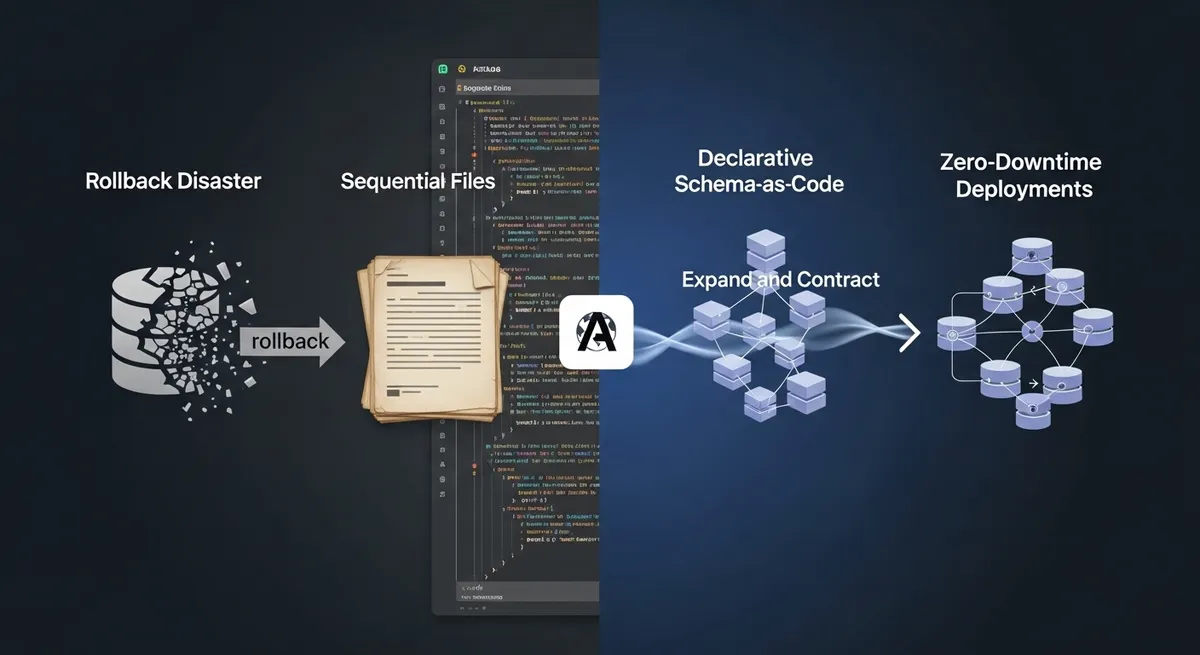
We’ve all been there. You’ve spent weeks refining a new feature, the CI pipeline is green, and you trigger the deployment. Five minutes later, the site is down. A sequential migration script failed halfway through because of a drift in the staging environment, and now your database is in a corrupted, half-migrated state. You try to roll back, but the old application code can’t read the new schema. You’re stuck in a 'rollback disaster' where neither the new nor the old version of your app works.
If this sounds familiar, you aren’t alone. According to recent research from Caylent, a staggering 94% of organizations miss deadlines on mission-critical database migrations, and only 6% manage to achieve true zero downtime. The problem isn’t your talent; it’s the toolset. We are still managing our most precious stateful assets with the digital equivalent of stone tools. It is time to shift toward Atlas database schema management and the 'Expand and Contract' pattern.
The Fundamental Flaw of Imperative Migrations
Traditional database migrations are imperative. You write a script that says: "Step 1: Add this column. Step 2: Rename that table." This works fine in a vacuum, but production is never a vacuum. When you manage migrations this way, you are managing the how rather than the what. This leads to environment drift, where your local DB, staging DB, and production DB all have slightly different histories, making your scripts unpredictable.
Modern infrastructure as code for databases solves this by moving to a declarative model. Instead of telling the database how to change, you define the desired end state in a schema file. Atlas acts like Terraform for your SQL tables. It inspects your current database, compares it to your desired HCL (HashiCorp Configuration Language) or SQL schema, and generates the safest possible plan to get there. This eliminates the 'out-of-sync' failures that plague manual scripts.
Mastering the 'Expand and Contract' Pattern
Even with great tooling, a single destructive change (like DROP COLUMN) can take down your site during a deployment. To achieve zero downtime, you must adopt the 'Expand and Contract' pattern, also known as the Parallel Change pattern. Instead of changing a column in one go, you break the process into distinct, backward-compatible steps.
Phase 1: The Expansion
First, you add the new structure without removing the old one. If you’re renaming user_name to full_name, you add the full_name column first. Both exist simultaneously. This ensures that the currently running version of your application—which still expects user_name—doesn’t crash when the database updates.
Phase 2: The Migration and Dual-Write
Next, you update your application logic to write to both columns. Simultaneously, you run a background job to migrate existing data from the old column to the new one. This is the 'Expand' phase of declarative database migrations. If you need to roll back the application at this point, no problem—the old column is still there and up to date.
Phase 3: The Contraction
Once you are 100% sure the new application code is stable and all data is moved, you 'contract' the schema by removing the old column. As Prisma’s Data Guide explains, this multi-phase approach is the only way to avoid ACCESS EXCLUSIVE locks that freeze your tables and kill performance during high-traffic periods.
How Atlas Prevents the Rollback Disaster
Atlas doesn’t just generate DDL; it acts as a safety net. It includes a sophisticated migration linting engine with over 50 analyzers. These analyzers catch common mistakes before they ever reach a human reviewer.
- Destructive Change Detection: Atlas will flag any plan that drops a column or table, forcing you to acknowledge the risk or use a more conservative strategy.
- Data Integrity Checks: It detects potential data loss, such as changing a column from
TEXTtoINTwithout a clear casting strategy. - Locking Risks: Atlas understands that
ALTER TABLEcan be a death sentence for large production databases. It identifies operations that will cause heavy locking and suggests concurrent alternatives.
By using Atlas database schema management, you decouple the schema change from the application deployment. You can apply the 'Expand' phase days before the code deploy, reducing the blast radius of your release window.
Declarative vs. Versioned: The Hybrid Reality
There is a healthy debate in the community: Should you go purely declarative (let the tool handle everything) or stay versioned (manual migration files)? Purely declarative workflows are amazing for development speed, but production often requires an audit trail. Atlas offers a 'Versioned Workflow' that gives you the best of both worlds. You define your schema declaratively, and Atlas automatically generates the versioned migration files for you. This maintains an immutable, reviewable history while removing the manual labor of writing SQL by hand.
The Cost of Doing Nothing
It is easy to argue that the 'Expand and Contract' pattern adds technical debt or overhead. Yes, writing dual-write logic takes more time than a simple RENAME. But consider the alternative. With 60% of data operations experiencing an outage in the last three years—and many resulting in losses exceeding $1M—the 'overhead' of safe migrations is actually an insurance policy. Atlas database schema management turns a high-stakes gamble into a boring, automated process.
Conclusion
The era of crossing your fingers during a db:migrate run is over. By embracing Atlas database schema management and the 'Expand and Contract' pattern, you move your database into the modern DevOps ecosystem. You gain the safety of linted, declarative changes and the reliability of zero-downtime deployments. Stop treating your database like a fragile artifact and start treating it like the code it is. Your SRE team (and your sleep schedule) will thank you.
Ready to modernize your workflow? Start by auditing your current migration scripts for destructive changes and explore how a declarative approach can simplify your next release.