The 'Homegrown Auth' Trap
I’ve seen this movie a dozen times. A startup team decides that using a library like jsonwebtoken and spinning up a /login endpoint is a 'weekend task.' It starts simple: a bcrypt-hashed password, a signed JWT, and a few lines of middleware. But as the app scales, the 'weekend task' morphs into a bottomless pit of security debt. You realize your token revocation strategy is non-existent, your signing keys are sitting in a plaintext environment variable, and your users are getting phished because they reuse the same password they used for a pizza delivery site in 2017.
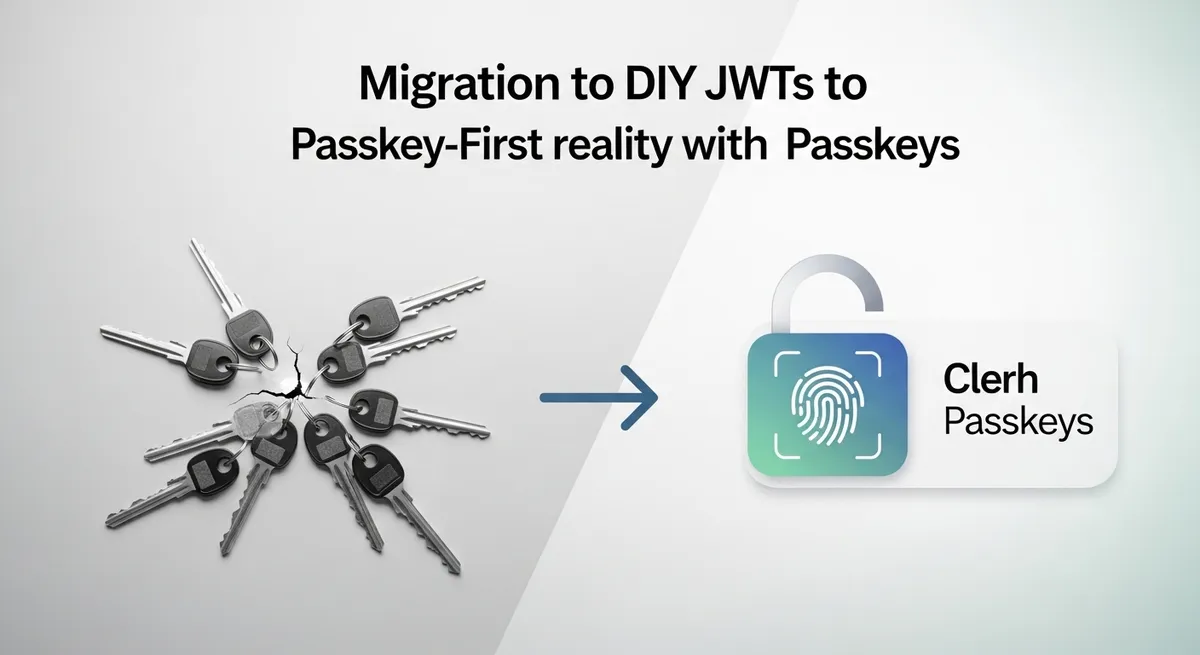
In 2025, building your own auth isn't just a waste of time—it’s a massive liability. With the rise of AI-powered credential stuffing and sophisticated JWT exploits, the game has changed. This is why a Clerk passkeys migration has moved from a 'nice-to-have' to a survival strategy for modern engineering teams.
The Invisible Rot in Your JWT Implementation
JWTs are the industry standard, but they are notoriously easy to mess up. I’m not just talking about the infamous 'alg:none' vulnerability that allowed attackers to bypass authentication by simply telling the server to stop checking signatures. I'm talking about the structural weaknesses of passwordless authentication security when it relies on legacy patterns.
When you DIY your auth, you're responsible for:
- Token Rotation: Implementing 60-second sliding windows without breaking the user experience.
- HttpOnly Enforcement: Ensuring tokens aren't accessible via XSS, which is harder than it sounds when you're managing cross-subdomain sessions.
- Secret Management: If your private key is leaked, every single session in your database is compromised instantly.
By contrast, managed providers like Clerk treat these as solved problems. They handle the heavy lifting of WebAuthn complexity out of the box, allowing you to focus on your actual product instead of worrying if your auth middleware has a logic flaw.
The 2025 Tipping Point: Why Passkeys Win
We have finally reached the 'FIDO Tipping Point.' Passkeys aren't a futuristic concept anymore; they are the mainstream expectation. According to the FIDO Alliance 2025 Trends report, nearly 70% of users have now enabled at least one passkey, and consumer awareness has spiked to 74%.
Passkeys replace the vulnerable 'shared secret' (the password) with asymmetric public-key cryptography. The private key never leaves the user's device—be it a MacBook's Secure Enclave, an Android's TPM, or a YubiKey. This makes them inherently phishing-resistant. You can't trick a user into typing a passkey into a fake site because the browser simply won't offer the credential unless the domain matches perfectly.
By the Numbers: Friction vs. Security
If security isn't enough to convince your CEO, show them the conversion data. Data from Google and Dashlane reveals a staggering performance gap:
- Passkey sign-ins are 50% faster (roughly 14.9s compared to over 30s for passwords).
- Login success rates jump to 92-93%, while traditional password/JWT methods languish at 63%.
- Dashlane specifically reported a 70% increase in sign-in conversion for users prompted with passkeys.
Every time a user has to reset a password, you lose money. Every time a JWT exploit forces a forced logout of your entire user base, you lose trust. A Clerk passkeys migration fixes both.
Navigating the Migration: From Legacy to Modern
The fear most CTOs have about switching to auth-as-a-service vs custom auth is the 'big bang' migration. Nobody wants to force 50,000 users to reset their credentials on a Tuesday morning. This is where Clerk’s architecture shines. You don't have to kill passwords overnight.
The strategy is 'Progressive Enhancement.' You can use Clerk's SDKs to allow users to log in with their legacy credentials and then, once authenticated, prompt them to 'Enable TouchID/FaceID for faster login.' This creates a passkey linked to their account without a single moment of friction. Within a few months, the majority of your active user base will have naturally migrated away from passwords.
Addressing the Elephant in the Room: Vendor Lock-in
Is there a trade-off? Yes. Moving to Clerk means adopting their ecosystem. Some developers worry about being 'locked in' to their UI components or session handling. However, compare the risk of vendor lock-in to the risk of a data breach. One is a business constraint; the other is a business-ending event. Furthermore, Clerk provides clear paths for exporting user data, ensuring you own your identity layer even if you outsource the execution.
The Hybrid Reality: Don't Alienate Your Users
While I'm a passkey maximalist, we have to be pragmatic. There are still users on older Windows machines or in restrictive corporate environments where hardware-backed keys aren't an option. The beauty of the Clerk passkeys migration is that it handles the 'Hybrid' mode for you. It intelligently detects if a browser supports WebAuthn and only offers the passkey flow when it’s actually possible, falling back to secure magic links or TOTP when necessary.
Final Thoughts
In the early days of the web, we built our own CSS frameworks, our own database drivers, and our own auth. Today, we've specialized. You wouldn't write your own encryption algorithm, so why are you still writing your own session management logic? Your auth layer should be a silent, invisible fortress, not a liability you have to patch every time a new CVE is released for a JWT library.
Embracing a Clerk passkeys migration allows you to delete thousands of lines of high-risk code and replace them with a system that is faster for users and impossible for hackers to phish. It’s time to stop treating authentication as a DIY project and start treating it as the critical infrastructure it is. If you're still managing signing keys and salt rounds in 2025, you're not being 'hardcore'—you're just being risky.
Ready to harden your app? Start by auditing your current JWT expiration and rotation policies. If you can't explain how you'd handle a leaked signing key in under five minutes, it's time to make the switch.