The Vector Database Honeymoon is Over
We’ve all been there. You build a RAG (Retrieval-Augmented Generation) pipeline, hook up a sleek vector database, and for the first week, it feels like magic. But then, the edge cases start crawling out of the woodwork. You ask your bot, "Which of our funded partners have suppliers in the EU?" and the LLM confidently hallucinates a list of companies that don't exist, or worse, gives you a generic paragraph about supply chains. This is the 'context gap'—the moment you realize that semantic similarity is not the same as logical reasoning.
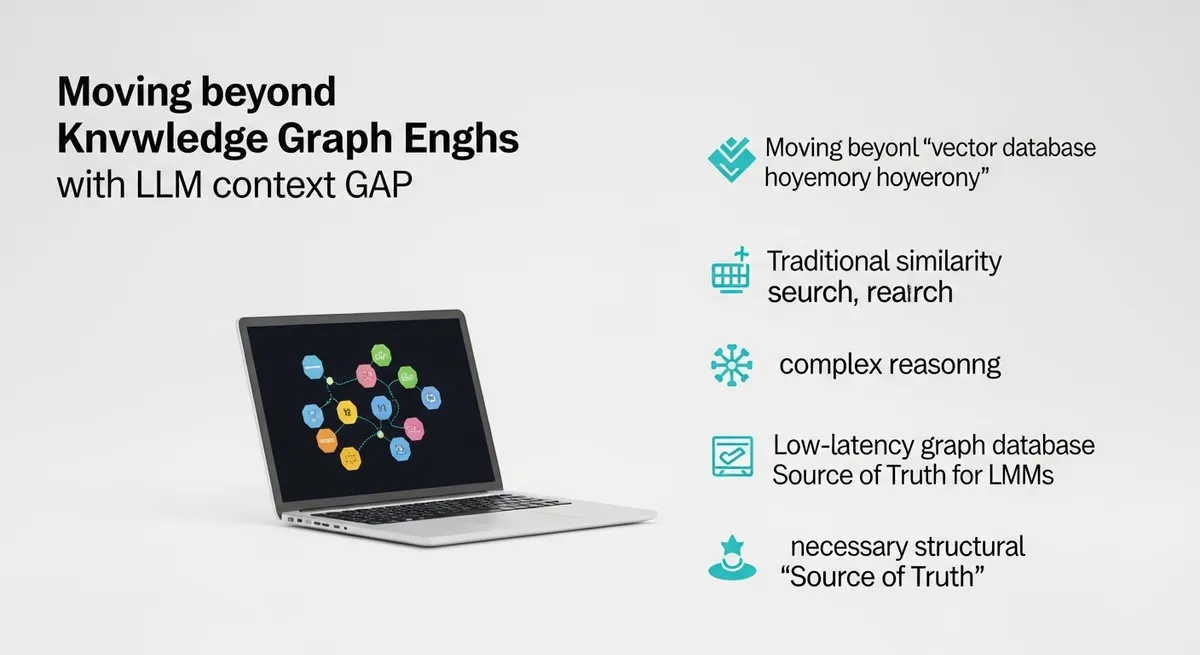
Vector databases are great at finding 'things that sound similar.' They are terrible at finding 'things that are related.' If you want to build enterprise-grade AI that doesn't just guess, you need a different architectural foundation. You need a FalkorDB knowledge graph RAG strategy.
Why Traditional Vector Search Fails at Reasoning
In the GraphRAG vs Vector Search debate, the fundamental difference lies in how data is structured. Vector search treats your data like a giant cloud of points. It’s excellent for finding a specific needle in a haystack, but it has no idea how those needles are connected. It lacks the 'connective tissue' of your business logic.
When an LLM tries to answer a multi-hop question using only vector retrieval, it often fails because the relevant pieces of information are scattered. The vector DB might pull a snippet about 'Company A' and another about 'EU Regulations,' but it misses the middle step: that Company A is a supplier for Company B, who is your actual partner. This structural blindness is a primary driver of LLM hallucination mitigation challenges. Without a graph, the model is forced to fill in the logical gaps with its own (often wrong) imagination.
FalkorDB: The C-Optimized Reasoning Engine
Enter FalkorDB. Born from the minds of the former RedisGraph team and recently backed by $3 million in seed funding, FalkorDB isn't just another graph database. It’s a complete rethink of how graph traversals should work in the age of AI.
Most graph engines are written in Java and struggle with heavy pointer-hopping and unpredictable garbage collection pauses. FalkorDB is C-optimized and treats the graph as a sparse matrix. By leveraging linear algebra instead of traditional pointer-chasing, it runs 'closest to the metal.' This isn't just academic—it translates to massive real-world wins. According to FalkorDB performance benchmarks, it can perform 2-hop traversals 2.9x faster than Neo4j, maintaining p99 response times under 140ms even under peak loads where competitors might spike to 40 seconds.
The Power of Sparse Matrices
Why does matrix algebra matter for your LLM? Because it makes complex reasoning queries practically instantaneous. When your RAG pipeline needs to traverse four levels of relationships to find the right context for a prompt, you can't afford to wait 5 seconds for a response. FalkorDB allows you to query deep relationships with sub-millisecond latency, ensuring your AI stays responsive and accurate.
GraphRAG vs Vector RAG: The Accuracy Gap
The proof is in the data. Recent studies on the KG-LM Accuracy Benchmark show a stark contrast. On schema-bound queries—things like KPIs, forecasts, and organizational dependencies—standard Vector RAG often scores 0%. It simply cannot aggregate data points that aren't semantically identical.
In contrast, a FalkorDB knowledge graph RAG approach pushes accuracy to 90% and beyond. Because the graph provides a rigid schema, the LLM isn't 'guessing' based on word embeddings; it's reading a factual map of your data. This makes your AI explainable. Instead of a 'black box' similarity score, you can see the exact Cypher query used to retrieve the data, providing a traceable path for every answer the LLM generates.
Hybrid Power: Combining the Best of Both Worlds
I’m not suggesting you delete your vector database. The 'sweet spot' for modern AI architecture is a hybrid approach. FalkorDB allows you to store vector indexes directly alongside graph entities. This means you can use semantic search to find an entry point into your graph, and then use the graph’s relationships to perform deep logical reasoning.
- Recall: Use vectors to find the most relevant 'starting' entities.
- Reasoning: Use the knowledge graph to follow relationships and find the hidden 'truth' across multiple hops.
- Response: Pass the perfectly curated, structured context to the LLM.
Overcoming the 'Indexing Tax'
Critics of GraphRAG often point to the 'indexing tax'—the effort required to turn messy, unstructured PDF dumps into a clean knowledge graph. It’s a fair point. Vector databases are 'plug-and-play,' while graphs require thought. However, FalkorDB is bridging this gap by developing automated KG creation tools. By using LLMs to extract entities and relationships during the ingestion phase, the process of building a knowledge graph is becoming as automated as generating embeddings.
The Verdict on FalkorDB Knowledge Graph RAG
As we move past the initial hype of generative AI, the focus is shifting from 'can it talk?' to 'can it be trusted?' Relying solely on vector similarity is a recipe for inconsistent, hallucination-prone applications. By implementing a FalkorDB knowledge graph RAG architecture, you give your LLM the structural 'source of truth' it needs to handle complex logic and enterprise-scale data.
If you're tired of your RAG pipeline failing at basic reasoning, it's time to stop chasing points in space and start mapping the relationships that actually matter. FalkorDB’s low-latency, matrix-based approach is the missing piece of the puzzle.
Ready to see the difference? Check out the FalkorDB documentation and start building a graph that actually understands your data.