The Anatomy of a Production Nightmare
It usually happens at 3:00 AM. You’re paged because a multi-step checkout process failed halfway through. The payment went through, but the inventory update timed out. Your manual retry logic kicked in, but because the third-party API wasn't perfectly idempotent, you’ve now double-charged a customer. You spend the next four hours manually reconciling database rows while cursing the 'simple' message queue architecture you built last quarter.
If this sounds familiar, you aren’t alone. A 2025 survey of over 220 backend engineers revealed that 75% of teams admit their processes are hampered by fragility and failure recovery issues. We’ve spent decades trying to solve distributed systems reliability by duct-taping SQS queues, Lambda functions, and database-as-a-queue patterns together. It’s time to admit it: this approach is a disaster.
The Fragility of the 'Queue and Hope' Pattern
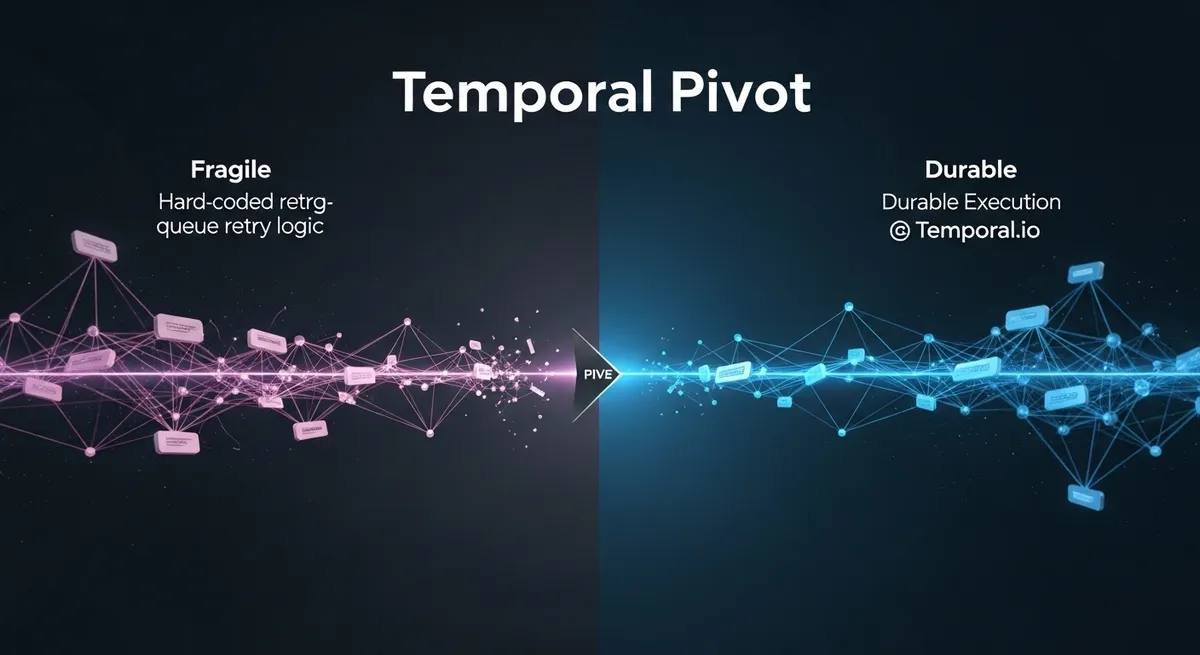
In a traditional event-driven architecture, we treat reliability as a series of isolated handoffs. Service A drops a message in a queue; Service B picks it up. If Service B fails, we retry. But what happens to the state of the overall business process? It lives nowhere. It’s scattered across logs, database flags, and dead-letter queues.
This 'manual plumbing' forces developers to become infrastructure engineers. You have to write custom logic for exponential backoff, handle 'ghost states' where a process is stuck in limbo, and ensure every single endpoint is perfectly idempotent. When you have ten services interacting, the cognitive load becomes a ceiling on how fast your team can ship. This is exactly where Temporal.io workflow orchestration enters the frame, shifting the paradigm from 'fire and forget' to 'durable execution'.
What is Durable Execution?
Durable Execution is a fancy way of saying your code is invincible. When you run a workflow in Temporal, the state of your local variables, the stack pointer, and the progress of your loops are all persisted. If the server running your code explodes, another worker simply picks up the execution history and resumes on the exact same line of code it left off. As noted by industry experts at The New Stack, this allows 'time to no longer be the enemy,' enabling processes to sleep for months and resume without complex schedulers.
Temporal.io Workflow Orchestration vs. The Status Quo
Why are giants like Netflix, Stripe, and Snap moving away from standard queues? Because Temporal.io workflow orchestration treats the entire lifecycle of a request as a single, stateful function. Let’s look at the core differences:
- State Persistence: In a queue-based system, if a worker crashes during a 10-step process, you have to figure out where it stopped. In Temporal, the history is the source of truth. Every 'await' point is a checkpoint.
- Error Handling: Instead of configuring complex retry policies in a YAML file or infrastructure console, you use standard
try/catchblocks in your code. - Visibility: Temporal provides a UI where you can see the exact state of every running workflow. No more grepping logs for hours to find out why an order is 'Pending'.
The Rise of Agentic AI and the Durability Imperative
The stakes for reliability have never been higher. As of late 2025, 94% of development teams are using AI tools, but only 39% have the infrastructure to support AI agents at scale. AI agents are inherently non-deterministic and long-running. They might take five minutes to 'think' and execute a tool call. Standard REST timeouts or short-lived Lambda executions simply cannot handle this.
This is why Temporal raised $300M in Series D funding recently—the industry is realizing that distributed systems reliability is the bottleneck for the AI revolution. If an AI agent is orchestrating a multi-step supply chain move, you cannot afford for that logic to 'disappear' because of a network blip. You need a platform that guarantees the code will eventually finish, regardless of infrastructure failures.
The 'Deterministic' Elephant in the Room
I wouldn't be a senior dev if I didn't mention the trade-offs. The biggest hurdle with Temporal is the determinism constraint. Because Temporal 'replays' your code to recover state, your workflow code cannot have side effects. You can’t call UUID.random() or http.get() directly inside the workflow function; these must be wrapped in 'Activities'.
This feels unnatural at first. It’s a steep learning curve for engineers used to writing procedural scripts. However, this constraint is a feature, not a bug. It forces a clean separation between your orchestration logic (the Workflow) and your execution logic (the Activity), leading to code that is significantly easier to unit test and maintain.
The Cost of Scale
Another point of contention is the 'action-based' billing in Temporal Cloud. While it removes the headache of managing your own clusters, high-throughput systems can see costs climb quickly. I’ve seen teams migrate back to self-hosted EKS deployments once they hit billions of actions. It’s the classic 'build vs. buy' struggle, but even with the overhead of self-hosting, the developer hours saved on debugging 'ghost states' usually justifies the investment.
Workflow-as-Code: Why It Wins
There is a segment of the industry that loves visual state machines—think AWS Step Functions. They look great in a slide deck. But for a software engineer, editing a 2,000-line JSON definition is a special kind of hell. Temporal.io workflow orchestration wins because it is code-first. You use Go, Java, Python, or TypeScript. You get IDE auto-completion, type safety, and version control. You can refactor a workflow just like any other piece of software.
Final Thoughts
The era of manually managing retries and state transitions is ending. As we move toward more complex, event-driven architectures and autonomous AI agents, the 'durable execution' model is becoming the standard. If your current system relies on a complex web of queues and 'retry-and-pray' logic, you are building on sand. It’s time to stop fighting the infrastructure and start using a platform that makes your code invincible.
Take a look at your most fragile microservice today. Ask yourself: if I pulled the plug on the server mid-execution, what would happen? If the answer involves manual data cleanup and a stressful morning, it’s time to give Temporal a serious look. Your future, well-rested self will thank you.