The Hook That Broke the Camel’s Back
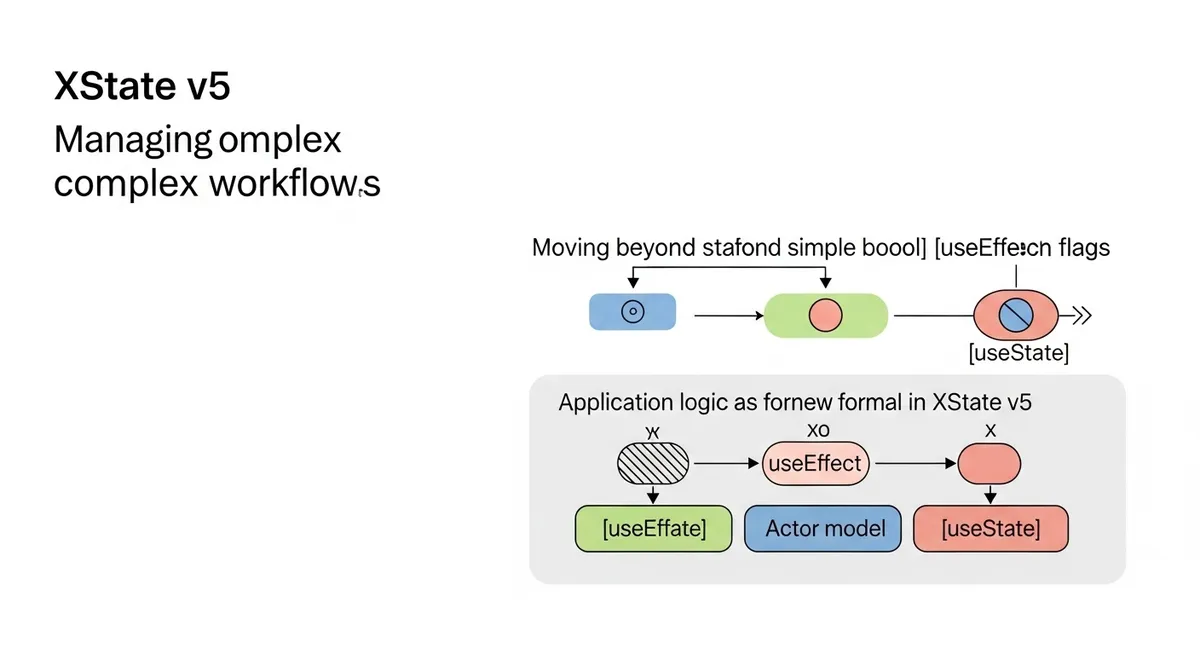
We have all been there. It starts with a simple useState for a loading spinner. Then comes a second boolean for the error state. Within a week, your component is a 'Twister' game of useEffect dependencies, isSubmitting flags, and if (!isLoading && !isError && data) checks. This is what I call 'boolean soup'—a fragile, implicit web of logic where the state of your application lives in the spaces between your variables rather than in the variables themselves.
As systems architects, we often treat application logic as a secondary citizen to the UI. We reach for store libraries like Zustand or Redux to move data around, but the behavior—the transitions, the race conditions, and the complex asynchronous flows—remains scattered. XState v5 state machines represent a fundamental pivot in this philosophy. It is no longer just a library for managing a toggle; it is a full-fledged logic layer built on the robust, mathematical foundation of the Actor model.
The Shift: From Machines to Actors
In previous versions, XState was largely seen as a state machine library you might use for a specific, complex component. With the release of XState v5, the scope has expanded. The library has moved from a machine-centric architecture to an actor-first model. In this paradigm, every piece of logic—whether it is a promise, an observable, or a full finite state machine—is an 'Actor' that can receive events, send messages, and manage its own internal state.
This shift matters because modern frontend applications are rarely linear. We are orchestrating multiple independent processes simultaneously. By treating logic as a formal model that exists independently of the UI, as highlighted in the official XState v5 launch, we turn our components into pure 'view' reflections of a deterministic engine. The UI asks 'What should I show?' and the logic layer answers based on a strictly defined state, not a lucky guess based on five different booleans.
The setup() API: TypeScript’s Best Friend
One of the biggest friction points in XState v4 was the 'typegen' dance. You had to run a watcher, wait for files to generate, and pray the types aligned. XState v5 solves this with the new setup() API. This provides first-class TypeScript inference out of the box. When you define your context, events, and actions within setup(), the rest of your machine inherits those types perfectly. No more manual casting; no more hidden any types lurking in your transition logic.
Eliminating Boolean Soup in the Real World
Consider a payment flow. You have credit card validation, 3D Secure redirects, inventory checks, and final confirmation. If you manage this with standard hooks, you risk 'impossible states'—like the user clicking 'Submit' twice while a promise is still pending, or an error message showing up while the success animation is playing.
Using finite state machines javascript patterns, these states become mutually exclusive. You are either in the 'validating' state or the 'processing' state. You cannot be in both. This isn't just about cleaner code; it's about reliability. A case study on XState v5 for payments demonstrates how these formal models prevent critical production failures by making the 'happy path' and the 'error path' equally explicit.
First-Class Logic Creators
V5 introduces specific logic creators that make non-machine logic feel like a native part of the ecosystem:
- fromPromise: Wraps any async function into an actor that can be invoked and tracked.
- fromTransition: A lightweight reducer-like actor for simpler state transitions.
- fromObservable: Streams data directly into your state architecture.
- fromCallback: For those messy, event-based legacy integrations.
By using createActor(logic, { input }), we can finally pass external data into our machines at initialization without the awkward 'assign on start' hacks of the past. This makes complex frontend workflow management feel less like a chore and more like building a reliable backend service that happens to run in the browser.
The Visual Collaboration Advantage
We often joke that the documentation is always out of date. With XState, the code is the documentation. By using Stately Studio, you can export your logic layer into a visual diagram. This serves as a 'living spec' that you can show to a Product Manager or a QA Engineer. When they ask, 'What happens if the API fails during the second step?', you don't have to hunt through 500 lines of useEffect. You just point to the error transition on the diagram.
Addressing the 'Overengineering' Elephant in the Room
I hear it often: 'Isn't this overkill for a login form?' If your login form is just two fields and a submit button, yes, XState v5 state machines might be more than you need. But software rarely stays simple. Requirements crawl. Today's login form is tomorrow's multi-factor authentication flow with biometric fallbacks and 'forgot password' modals.
The learning curve is real. Your team will need to understand the difference between actions and actors, and the mental model shift from 'event-driven' to 'state-driven' takes time. However, the cost of the learning curve is paid back in the debugging phase. Because XState is deterministic, you can track every event that led to a specific state. While standard browser call stacks can be messy due to the asynchronous nature of the Actor model, the clarity of the state transitions usually makes the 'how did we get here?' question trivial to answer.
The Future: Universal Orchestration
Interestingly, XState v5 isn't just staying in the browser. There is a growing movement using XState for backend orchestration, positioning it as an open-source alternative to heavy-duty tools like AWS Step Functions. Because the logic is pure and serialized, you can run these machines on a server, pause them, save the state to a database, and resume them when a user clicks a link in an email three days later.
Final Thoughts
We need to stop treating our logic as an afterthought to our components. By implementing XState v5 state machines, you are building a resilient, testable, and visual foundation for your application. You are moving away from the chaos of boolean soup and toward a world where your code actually matches the mental model of your business requirements.
Next time you find yourself adding a fifth isLoading variable to a component, stop. Ask yourself if you are building a logic layer or just adding more ingredients to a soup that’s already starting to spoil. It might be time to let the actors take the stage.
Ready to dive in? Check out the official documentation or try modeling your most complex 'problem child' component in the Stately Editor today.