The Vector Wall: Why Your RAG Pipeline is Stalling
We’ve all been there. You build a Retrieval-Augmented Generation (RAG) system using a vector database, and the initial demo looks like magic. But as soon as your CTO asks a complex question—something like, 'How do our Q3 supply chain disruptions in Southeast Asia affect our 2025 revenue forecasts for the electronics division?'—the system crumbles. It returns a handful of semi-relevant text chunks about 'supply chains' and 'electronics,' but it fails to connect the dots. The Large Language Model (LLM) gets lost in a sea of fragmented context, eventually hallucinating a generic answer that helps no one.
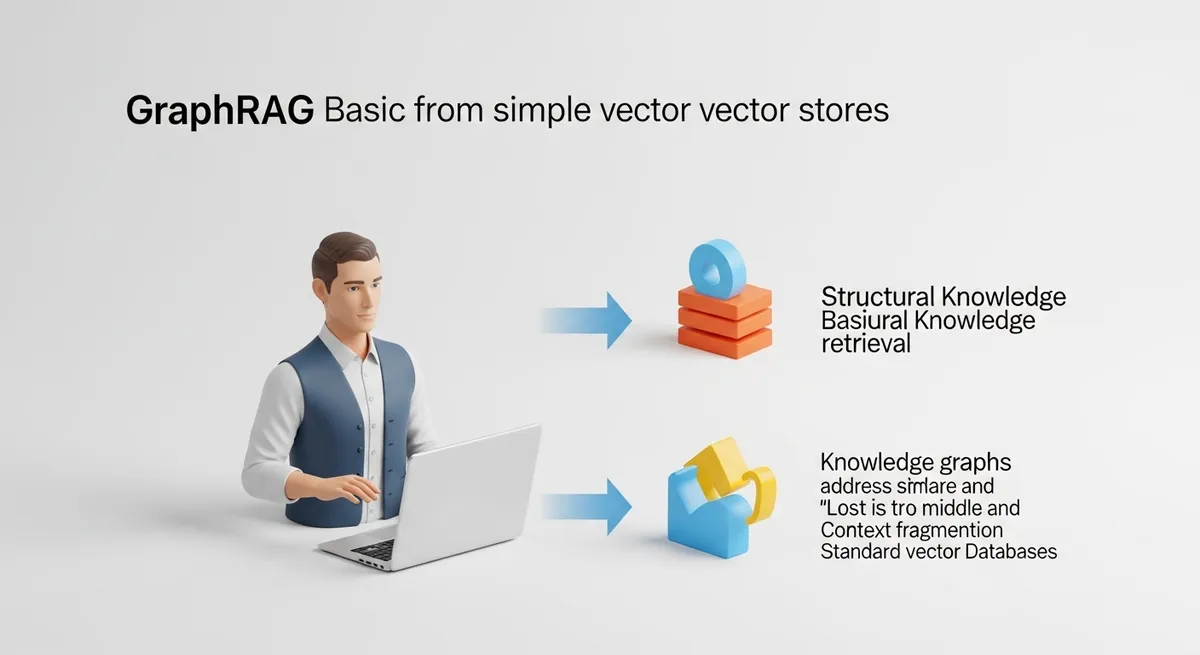
The hard truth is that vector databases are fantastic for finding needles in haystacks, but they are terrible at understanding the hayfield itself. Semantic similarity is not the same as structural knowledge. This is where GraphRAG enters the frame, moving us beyond simple cosine similarity toward a world where AI actually understands the relationships between entities.
The Fundamental Flaw of Flat Embeddings
Standard RAG relies on chunking documents into flat lists of vectors. When you query the system, it grabs the top 'k' chunks that look mathematically similar to your prompt. However, this 'top-k' approach suffers from the 'lost in the middle' problem. Research shows that as you stuff more chunks into an LLM's context window, its ability to utilize the information in the middle of that window drops off a cliff. If the crucial link between two departments is buried in chunk #7 of 15, your LLM might never 'see' it.
Furthermore, standard vector RAG accuracy degrades to near zero as the number of entities per query increases. According to benchmarks from FalkorDB, vector-only systems often fail entirely on schema-bound queries that require multi-hop reasoning. If your query requires jumping from a 'Product' to a 'Vendor' to a 'Location' and finally to a 'Risk Score,' a vector database simply cannot guarantee that all those disparate pieces of the puzzle will be retrieved together.
What is GraphRAG?
GraphRAG is an architectural shift that combines the power of LLMs with Knowledge Graphs. Instead of treating your data as a collection of isolated text snippets, GraphRAG maps your data into a web of nodes (entities) and edges (relationships). When an LLM queries a GraphRAG system, it doesn't just look for 'similar' text; it traverses the graph to find structurally relevant information.
One of the most significant breakthroughs in this space comes from Microsoft Research. Their implementation uses community detection—specifically algorithms like Leiden—to pre-summarize the entire dataset into hierarchical clusters. This allows for 'Global Search,' where the LLM can answer high-level questions about a whole corpus without needing to read every single document in real-time. It’s like giving your AI an automated executive summary of every relationship in your company.
Global vs. Local Search: Two Sides of the Same Coin
GraphRAG provides a dual-threat capability that vector databases can't match:
- Local Search: This is for deep-diving into specific entities. If you ask about a specific employee, the graph can instantly pull their manager, their projects, and their recent Jira tickets by following explicit edges.
- Global Search: This handles the 'thematic' questions. By using pre-generated community summaries, the system can synthesize information across thousands of documents to provide a holistic view of the data.
The High-Fidelity Advantage: Why Architects are Switching
For AI Engineers and Data Architects, the move to GraphRAG isn't just about 'better' search; it's about structural fidelity and explainability. In high-stakes industries like finance or healthcare, 'because this chunk looked similar' isn't a good enough reason for an AI's decision. GraphRAG provides an auditable traversal path. You can see exactly which nodes and relationships were used to generate an answer, providing a level of provenance that vector-only systems lack.
In enterprise benchmarks, particularly the KG-LM framework, GraphRAG has been shown to improve accuracy for complex business queries from a meager 16.7% to over 56%. With the 2025 wave of SDKs and tighter Neo4j LangChain integration, we are seeing those numbers push past 90%. It turns out that when you give an LLM a map of the data instead of a pile of postcards, it performs significantly better.
The Trade-offs: It’s Not All Sunshine and Nodes
I’d be doing you a disservice if I said GraphRAG was a free lunch. It isn't. Building a Knowledge Graph (KG) comes with a significant upfront 'tax.' You have to define a schema, extract entities, and handle the computational cost of building the graph. This is the 'Cold Start' problem. A vector DB is useful the second you embed a document; a graph requires ingestion, cleaning, and relationship mapping before it shines.
There is also the matter of latency. Traversing a graph with billions of nodes is computationally more intensive than a vector search. However, the industry is settling on a Hybrid Architecture: using vector search for broad recall and knowledge graphs for relational consistency. This hybrid approach allows you to get the speed of vectors with the precision of graphs.
Moving Forward: The Slope of Enlightenment
Gartner’s 2024-2025 AI Hype Cycle places Knowledge Graphs as a 'Critical Enabler' on the 'Slope of Enlightenment.' We are moving past the peak of 'just use a vector DB for everything' and into a more mature phase of AI architecture. If you are building for the enterprise, you can no longer afford to ignore the structural relationships within your data.
If you're currently struggling with LLM hallucinations or poor retrieval on complex datasets, it’s time to look Beyond the Vector Store. Start by identifying the most critical relationships in your data. You don't have to map your entire organization on day one—start with a specific domain, use tools like LangChain to integrate your existing graph database, and watch your retrieval accuracy soar.
The future of RAG isn't just about finding the right text; it's about understanding how your world is connected. Are you ready to stop searching and start connecting?