The Great Mocking Lie
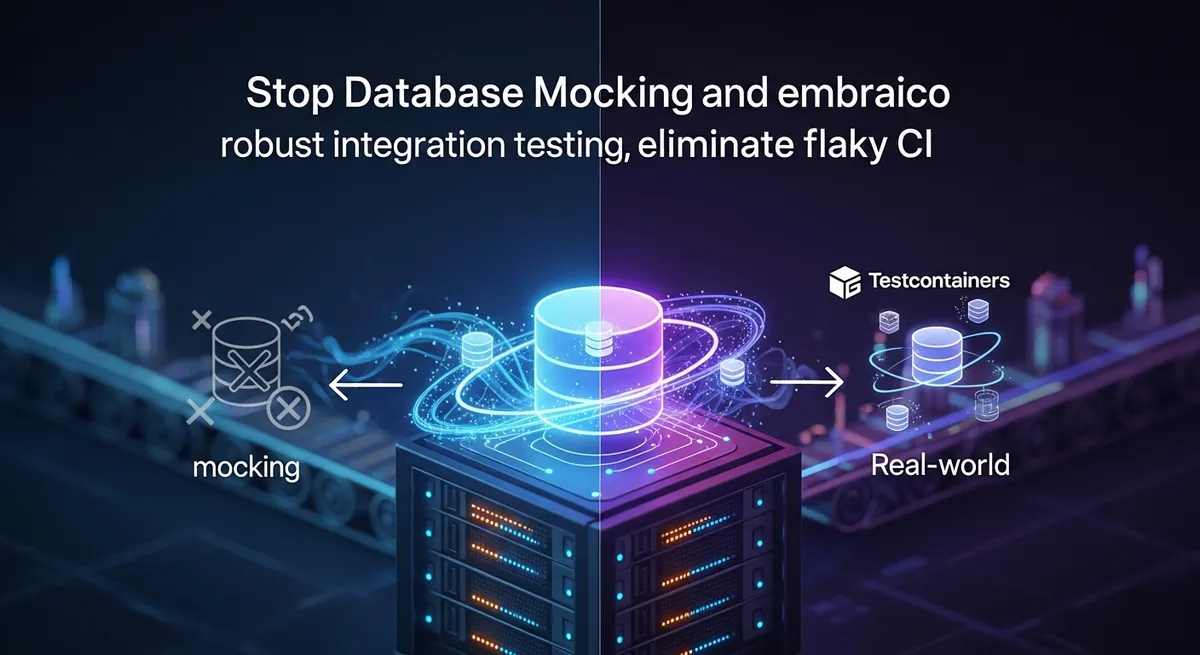
We have all been there. Your CI pipeline is glowing green, your unit test coverage is a pristine 90%, and your Slack notifications are quiet. You deploy to production with the confidence of a developer who has 'verified everything.' Ten minutes later, the Sentry alerts start screaming. It turns out that while your mock object perfectly simulated a successful database save, the actual PostgreSQL instance in production didn't appreciate that unique constraint violation or the specific JSONB syntax you used.
The hard truth is that mocks are convenient liars. They tell us what we want to hear, not what the database will actually do. For years, we relied on in-memory substitutes like H2 or complex Mockito setups because they were fast. But as the 2025 Docker State of Application Development Report points out, with 92% of the industry now running containers, there is no longer a valid excuse to simulate your infrastructure when you can simply run the real thing. This is where Testcontainers database integration testing transforms from a 'nice-to-have' into a mandatory standard for reliable software delivery.
The 'Real-World' Integration Pattern: Why Mocks Fail
When we talk about integration testing vs mocking, we are really talking about the gap between theory and reality. A mock cannot tell you if your migration script is missing a column. It won't warn you that your transaction isolation level is causing deadlocks under load. Most importantly, it completely ignores the dialect-specific features that make modern databases powerful.
The Four Fatal Flaws of Database Mocking
- Constraint Ignorance: Mocks don't care about Foreign Keys or Check Constraints. Your code might try to link a record to a non-existent parent, and the mock will smile and return true.
- Query Syntax Errors: Using a window function or a specific Postgres operator? A mock repository just returns a canned list, hiding the fact that your SQL is syntactically invalid.
- Transaction Behavior: Mocks don't roll back. If your service method fails halfway through, a mock won't show you the partially committed data mess left in your wake.
- Version Mismatches: Production might be on Postgres 16, but your local H2 simulates an environment that doesn't support the same indexing strategies or data types.
By shifting to a 'Real-World' integration pattern, you ensure that every developer and CI runner is interacting with a disposable, production-identical instance of your stack.
Enter Testcontainers: Ephemeral Docker Test Environments
Testcontainers is an open-source library that allows you to manage ephemeral docker test environments directly from your code. Instead of a shared 'test database' that everyone breaks, or a clunky Docker Compose file you have to remember to 'up' before running tests, the lifecycle of the database is tied to the lifecycle of the test suite.
When the test starts, Testcontainers pulls the exact image version you use in production, spins it up, and provides your application with the connection credentials. When the test finishes, the container vanishes. No cleanup, no 'test pollution' from previous runs, and no manual setup. This is the key to CI/CD pipeline reliability.
Framework Maturity: Spring Boot and .NET Lead the Way
One of the biggest hurdles to adopting Testcontainers used to be the 'boilerplate tax.' You had to manually map ports, wait for the container to be ready, and inject properties into your application context. Those days are gone. Modern frameworks have embraced the 'Real-World' pattern natively.
Take Spring Boot 3.1+, for example. The introduction of the @ServiceConnection annotation has been a game-changer. As detailed in the Spring Boot 3.1 ConnectionDetails report, you no longer need to write DynamicPropertySource blocks to glue your container to your app. You simply declare the container, and Spring automatically wires the JDBC URL, username, and password. This makes Testcontainers database integration testing almost as easy to implement as a standard unit test.
Local Development Revolution
The benefits extend beyond CI. Developers are now using Testcontainers to replace manual Docker Compose setups for local development. By using the 'dev' mode in Spring Boot or .NET, your application can spin up its own database dependencies the moment you hit 'run' in your IDE. This ensures that every developer on the team is working against the exact same environment, effectively killing the 'it works on my machine' excuse once and for all.
Addressing the Elephant in the Room: Speed vs. Fidelity
I hear the purists already: "But spinning up a Docker container takes 10 seconds! My unit tests take 10 milliseconds!"
You are right. There is a trade-off. If you have 5,000 tests, running a fresh container for every single one is a recipe for a 3-hour CI build. However, the community has found a middle ground. The pattern is shifting toward Shift-Left Strategy: use pure unit tests with mocks for complex business logic that doesn't touch the DB, but use Testcontainers for every repository-level test and end-to-end flow.
To mitigate the speed issue, you can use the 'Singleton Container Pattern,' where one container instance is shared across the entire test suite, or leverage Testcontainers Cloud. These solutions offload the container execution to a remote worker, bypassing the resource constraints of your local machine or underpowered CI runners.
The Deterministic CI Advantage
The most significant impact of Testcontainers database integration testing is the elimination of 'flaky' tests. Most flakes in CI are caused by shared state—data left behind by a previous test that causes the next one to fail. Because Testcontainers provides a clean, isolated environment for every run (or every suite), you achieve a level of determinism that mocks simply cannot provide. As Michal Drozd notes in his analysis on stopping the mocking era, catching an edge case like deleted_at logic early saves hours of debugging in production.
The Verdict: Stop Settling for False Confidence
If you are still mocking your database repositories in 2025, you are testing a fantasy. Your code doesn't run against a HashMap in production; it runs against a complex, stateful engine with its own quirks and rules. Testcontainers database integration testing bridges the gap between your development environment and the real world, providing a safety net that mocks can never offer.
It is time to move beyond the convenience of lying tests. Start by replacing one 'brittle' integration test with a Testcontainers-backed one. Your CI/CD pipeline—and your sleep schedule—will thank you.
Next Steps for Your Team
- Audit your current test suite: identify which tests frequently 'pass' but still result in production bugs.
- Update to the latest framework versions (Spring Boot 3.1+ or .NET 8) to leverage native container support.
- Experiment with the Reusable Containers feature to speed up local development cycles.
- Stop mocking what you can verify for real.