The Great Ingress Annotation Hangover
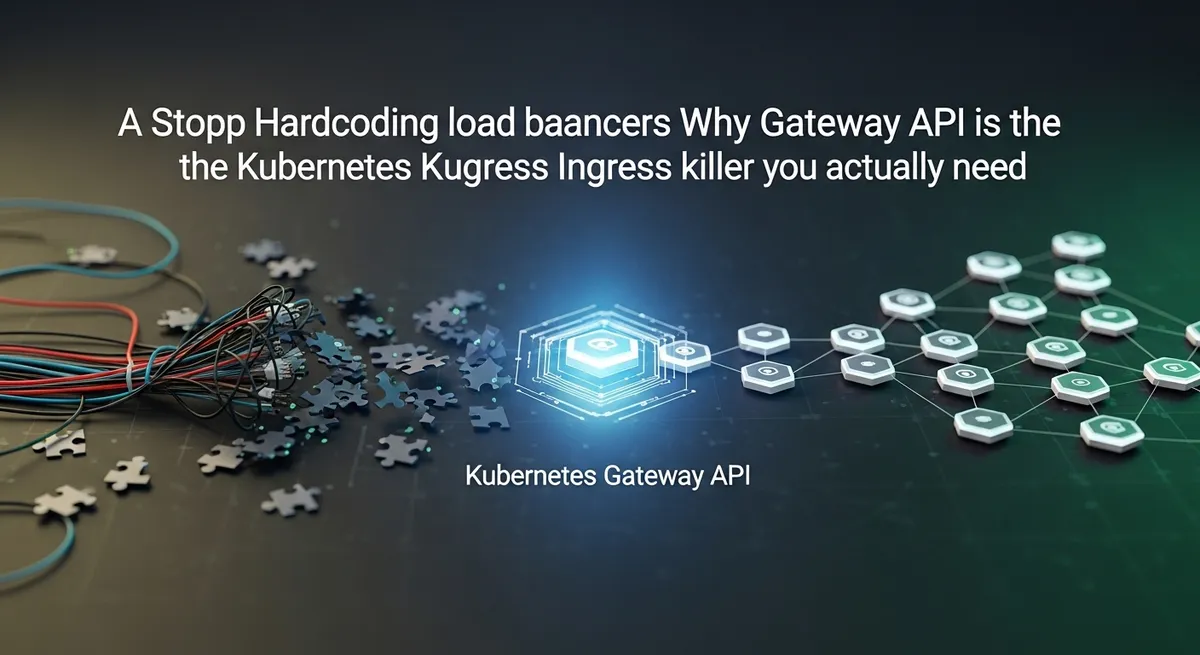
If you have spent any time managing production clusters, you know the feeling of opening an Ingress manifest and seeing forty-five lines of nginx.ingress.kubernetes.io/ annotations. We’ve been duct-taping our traffic management for years. Want a simple rewrite? Annotation. Need a specific timeout? Annotation. Need basic Canary deployments? That’s another three annotations and a prayer to the YAML gods. The Kubernetes Gateway API didn't just arrive to fix these minor annoyances; it arrived to dismantle the fundamental architectural bottleneck that has plagued cloud-native networking since 2015.
The legacy Ingress API was a 'lowest common denominator' design. It assumed every load balancer worked the same way, which we quickly realized was a myth. To make things actually work, every vendor had to shove their proprietary features into the metadata.annotations field. This created a fractured ecosystem where your configuration wasn't just platform-specific—it was brittle. The Kubernetes Gateway API is the industry’s collective admission that we need a better, more expressive way to handle how traffic enters our clusters.
The Multi-Tenant Shift: Who Actually Owns the Traffic?
One of the biggest friction points in the K8s Ingress vs Gateway API debate is the separation of concerns. In the old world, a single Ingress resource was a messy soup of infrastructure settings (TLS certificates, IP addresses) and application logic (path routing, service backends). If a developer wanted to change a path, they needed permissions that often over-indexed on infrastructure control.
The Gateway API introduces a role-oriented resource model that mirrors how real engineering teams actually function:
- GatewayClass: Managed by the Infrastructure Provider. It defines what kind of load balancer is available (e.g., an AWS ALB or a Cilium-based mesh).
- Gateway: Managed by the Cluster Operator. This defines where the traffic enters, handling the IP and TLS termination.
- HTTPRoute: Managed by the Application Developer. This defines how traffic gets to the app, focusing purely on logic like headers and paths.
By splitting these responsibilities, platform teams can give developers the autonomy to manage their own routing without the risk of them accidentally blowing up the entire cluster’s load balancer configuration.
Standardizing the Non-Standard
One of the most significant advantages of the Kubernetes Gateway API is how it handles advanced traffic patterns as first-class citizens. For years, if you wanted to perform a weighted traffic split for a blue-green deployment, you were at the mercy of your specific controller's implementation. According to analysis by Plural, the operational risk of sticking with the deprecated Ingress-NGINX model is growing, especially as the community shifts focus toward these more modular standards.
With Gateway API, features like traffic splitting, header manipulation, and cross-namespace routing are built directly into the spec. You no longer need to learn a different syntax every time you move from a GKE environment to an EKS environment. The API surface remains consistent, whether you are using Istio, Kong, or native cloud controllers.
Beyond HTTP: L4 and Modern Protocols
Ingress was always an HTTP-first (and largely HTTP-only) construct. If you needed to handle TCP, UDP, or gRPC, you often had to resort to service-type LoadBalancers or complex controller-specific hacks. The cloud-native networking landscape has evolved past simple web traffic. The Gateway API brings native support for TCPRoute, UDPRoute, and GRPCRoute. This means your gRPC-based microservices or your specialized UDP gaming backends finally have a standardized way to manage ingress traffic without jumping through hoops.
Is it Overkill for Small Teams?
There is a valid argument that for a single-developer shop, moving from one Ingress file to three distinct resources (GatewayClass, Gateway, Route) feels like unnecessary complexity. This is the 'Complexity Paradox.' However, the Kubernetes official blog recently highlighted the release of Gateway API v1.4, which has graduated features like BackendTLSPolicy to the GA channel. The message from the maintainers is clear: the ecosystem is moving this way. Even if you don't need the complexity today, the tooling, security patches, and community support for the old Ingress-NGINX controller are on a countdown. Staying on Ingress is effectively technical debt that is accruing interest every day.
Transitioning Without the Trauma
The good news is that this isn't a 'rip and replace' operation. The Kubernetes Gateway API is designed to coexist with your existing Ingress resources. You can begin by migrating a single, non-critical service to a Gateway-managed route while leaving the rest of your legacy stack untouched. Most modern controllers like Cilium and Linkerd allow you to run both side-by-side during the transition period.
The real 'killer' feature here isn't just the technical spec—it's the future-proofing. As you scale into multi-cluster environments or start looking at service mesh traffic management, the Gateway API serves as the common language. It allows your infrastructure to grow without requiring a complete rewrite of your routing logic every time you change your underlying network provider.
Conclusion
The era of the annotation-stuffed Ingress manifest is ending. While the initial jump to the Kubernetes Gateway API might feel like adding extra steps, the long-term benefits of role-based governance, multi-protocol support, and vendor portability are undeniable. We are moving away from 'hacking' our load balancers and toward a model where infrastructure is as structured and typed as our code. If you haven't yet, now is the time to spin up a Gateway controller in your dev environment and see the difference for yourself. Your future self—the one not debugging a regex error in a 200-character annotation—will thank you.