The Great Style Fragmentation Problem
Let’s be honest: styling in React Native has always felt like the awkward middle child of the development world. You’re either trapped in the verbosity of StyleSheet.create, manually mapping every margin and padding, or you're fighting with inline styles that turn your component logic into a cluttered nightmare. For those of us moving between web and mobile, the context switching is a productivity killer. Why should a flex-1 on the web requires a completely different mental model on iOS?
The dream of a 'Universal Design System' has often been just that—a dream. But with the release of NativeWind v4, the gap between the web’s utility-first efficiency and native’s performance requirements has finally closed. This isn't just another wrapper; it is a structural rethink of how we ship interfaces across platforms.
The Architecture Shift: Goodbye Babel, Hello lightningcss
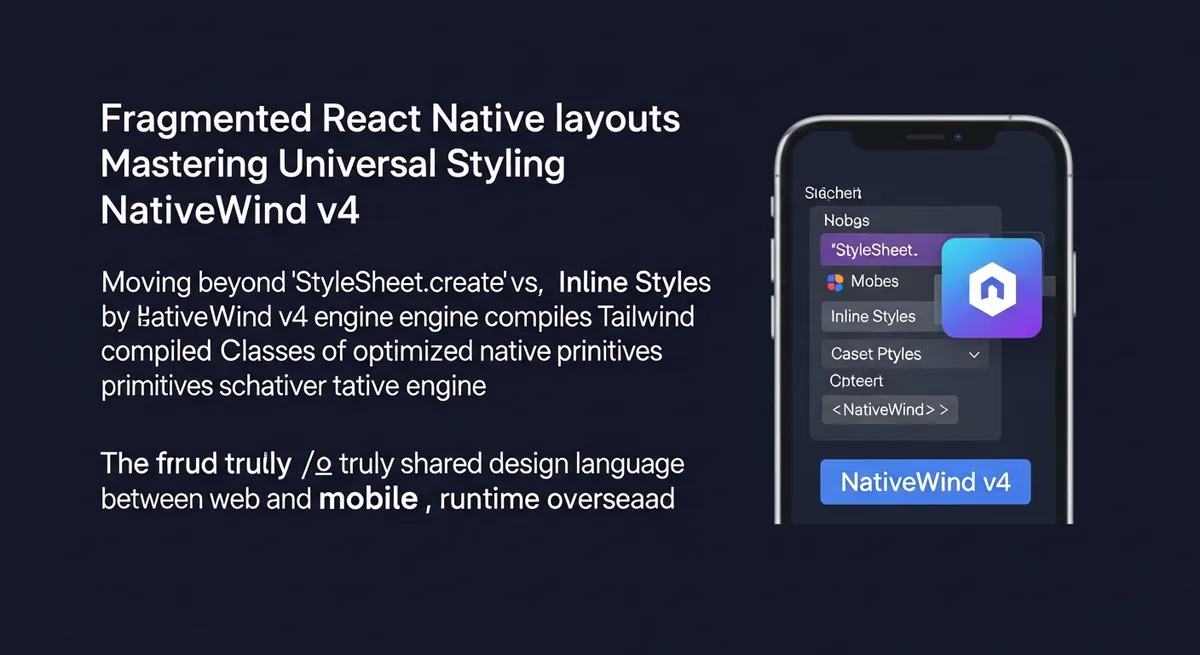
Previous iterations of NativeWind relied heavily on Babel plugins to transform class names. While it worked, it was brittle and often felt like we were hacking the build process. NativeWind v4 flips the script by moving to a specialized compiler powered by lightningcss. By leveraging a jsxImportSource transform, NativeWind now preserves your className strings and processes them through a dedicated engine that outputs optimized native primitives at build time.
According to the NativeWind v4 Announcement, this transition allows the library to align with the standard React compilation pipeline. This means better predictability across Metro for your mobile builds and Vite or Webpack for your web builds. You aren't just 'faking' CSS on mobile anymore; you are using a compiler that understands the nuances of both environments.
Why Build-Time Compilation Matters
Early CSS-in-JS libraries for React Native suffered from a 'runtime tax.' Every time a component rendered, the library had to calculate styles, map them to native properties, and inject them. In a complex list with hundreds of items, this caused visible frame drops. NativeWind v4 avoids this by doing the heavy lifting during the build phase. When your app runs, it’s using optimized StyleSheet objects that are nearly indistinguishable from those created manually.
Universal Design Systems and RSC Readiness
The tech industry is currently obsessed with React Server Components (RSC), and for good reason. The ability to shift logic to the server is a game-changer for performance. However, styling in an RSC world is tricky because you can't rely on traditional runtime hooks. NativeWind v4 was architected specifically with RSC and Suspense in mind. By moving style resolution out of the render cycle, it enables seamless styling in server-rendered native environments—a feat that many traditional styling libraries still struggle to achieve.
Furthermore, v4 introduces native support for CSS Variables. This is the 'holy grail' for design tokens. You can now define a --primary-color in a global CSS file and have it automatically recognized by your React Native components. No more duplicate theme.ts files or complex mapping functions. Your design system becomes truly platform-agnostic.
Addressing the Performance Elephant in the Room
Whenever a new styling library hits the scene, the first question is always: 'Is it slower than StyleSheet.create?' The short answer is: in real-world applications, you won't notice a difference. While some performance benchmarks show a microscopic startup overhead of around 2ms on the JS thread, the rendering performance of NativeWind v4 achieves parity with native primitives for complex components.
It’s important to look past synthetic '1,000-component render tests.' In a real app, the developer velocity gained from using utility classes far outweighs a 2ms startup delay. Plus, because v4 preserves classNames, it plays beautifully with third-party management libraries like tailwind-variants, cva, and clsx, allowing you to build complex, state-driven UI components without the typical performance bottlenecks of custom style logic.
The Nuances: Flexbox and the 'Styled' HOC
It wouldn't be a fair assessment without mentioning the friction points. If you are coming from NativeWind v2 or v3, the biggest shock is the removal of the styled() higher-order component. The v4 philosophy encourages using className directly on components. While this is cleaner in the long run, it requires a shift in mindset for those who preferred the component-centric API.
Additionally, the 'Web vs. Native' flexbox defaults remain a primary source of confusion. In Tailwind for web, the default flex-direction is row. In React Native, it’s column. NativeWind doesn't 'fix' this because doing so would break the underlying native behavior developers expect. You still need to be conscious that while the syntax is shared, the layout engine still follows native rules. Using flex-col or flex-row explicitly is a habit you’ll want to pick up quickly.
Experimental Animations and Beyond
One of the most exciting additions in NativeWind v4 is the experimental support for animations. By leveraging react-native-reanimated, you can now use Tailwind-like animation classes such as animate-pulse or animate-bounce. This effectively abstracts away the complexity of the Animated API for standard UI transitions, making it easier than ever to add that final layer of polish to your mobile apps without writing fifty lines of boilerplate code.
The Verdict: Is It Production Ready?
With official backing and usage by industry leaders like Shopify and Expo, NativeWind v4 has moved past the 'experimental' phase. It is now a production-ready standard for the React Native ecosystem. It offers a level of developer experience that was previously unavailable, allowing teams to share a design language across platforms without sacrificing the performance that native users demand.
If you're starting a new Expo project or looking to refactor a messy internal design system, NativeWind v4 is the most compelling argument for utility-first styling we've ever seen in the mobile space. Stop fighting your styles and start building. Your future self (and your users) will thank you.
Are you ready to ditch the StyleSheet boilerplate? Try migrating one small component to NativeWind v4 today and feel the difference in your workflow. If you've already made the switch, drop a comment and share your performance findings—let's build a better mobile web together.