The End of the VRAM Monopoly
I recently tried to spin up a Llama 3.1 405B instance on a major cloud provider. After looking at the quote for an 8-node H100 cluster, I realized I could either fund a small startup or run a single inference job for a month. The 'VRAM Wall' is real, and for most independent researchers and DevOps architects, it’s a barrier that feels insurmountable. But what if we stopped trying to own the whole stack? What if we treated LLM inference the way we used to treat file sharing in the early 2000s? Welcome to the era of distributed llm inference, where your local 3090 is just one node in a global, decentralized brain.
The BitTorrent Moment for Artificial Intelligence
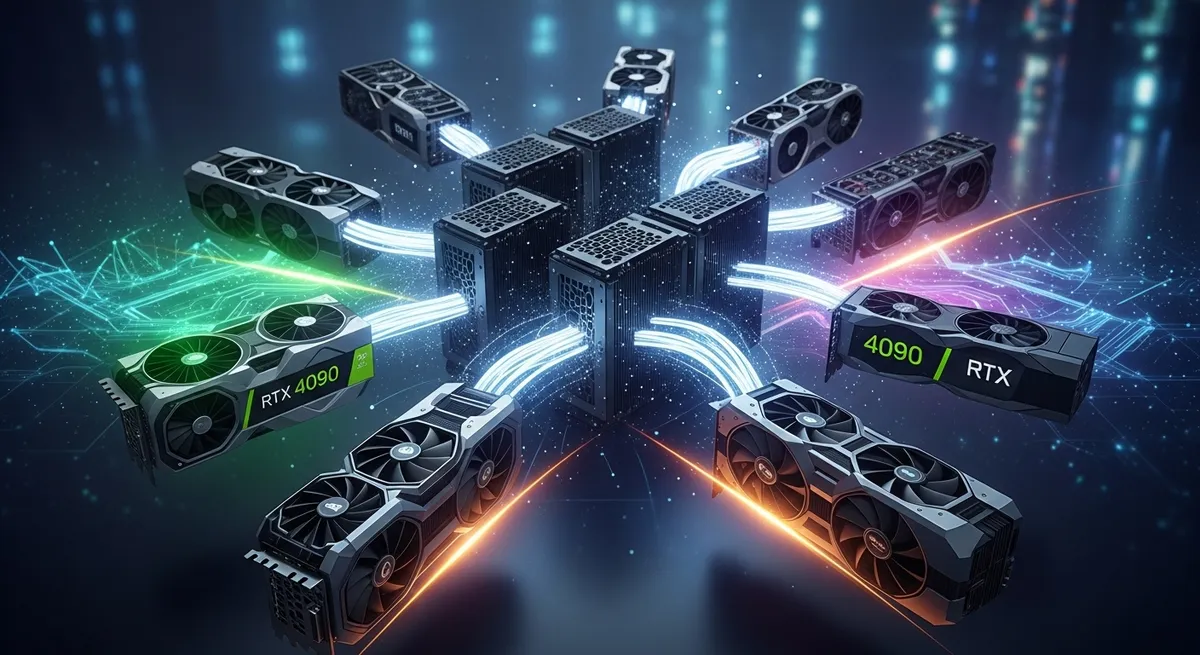
The core problem with massive models like Llama 3 70B or the behemoth 405B is their footprint. A 70B model at FP16 precision requires roughly 140GB of VRAM just to load the weights. That is physically impossible on any consumer card. Even with 4-bit quantization, you are pushing the limits of a dual-3090 setup. This is where Petals enters the chat. Petals operates on a 'swarm' architecture, sharding transformer blocks across a network of peers.
Think of it as BitTorrent for AI. Instead of downloading a file, you are 'downloading' the computation. When you run a prompt through a Petals swarm, your local machine handles the initial embeddings, then ships the intermediate tensors to a peer who owns layers 1 through 10. That peer processes them and hands them off to the next person in the chain. By the time the data returns to you, it has traversed a dozen different GPUs across the globe, yet you get the final token back in near real-time.
ExLlamaV2 and the Magic of Mixed-Bitrate Quantization
While Petals manages the network, ExLlamaV2 is the engine making the local nodes actually viable. If you've been using GGUF or standard GPTQ, you're leaving performance on the table. ExLlamaV2’s EXL2 format is a game-changer for decentralized AI hosting because it allows for mixed-bitrate quantization. You can quantize the most critical layers at 8-bit and the less sensitive ones at 3-bit, squeezing a massive model into a 24GB buffer without the massive perplexity hit usually associated with heavy compression.
Why ExLlamaV2 Performance Matters for Swarms
- Memory Efficiency: Fits larger model shards into cheaper consumer hardware.
- Flash Attention Integration: Drastically reduces the memory overhead of long context windows.
- Kernel Optimization: Designed specifically for NVIDIA's Ada and Ampere architectures, squeezing every teraflop out of a 4050 or 3090.
The Architecture of a Swarm: Layer Sharding and Fault Tolerance
One of the biggest concerns with distributed llm inference is what happens when 'xX_Gamer_Xx' shuts down his PC in the middle of your request. This is handled by the Hivemind library, the backbone of Petals. The network is dynamically redundant. If a node providing layers 20-30 drops off, the request is instantly rerouted to another peer hosting those same layers. It’s a self-healing mesh that prioritizes availability.
In terms of speed, we aren't talking about the 300 tokens per second you'd get from an H100 NVLink cluster. However, Petals has demonstrated 5-6 tokens per second for Llama 2 70B models. For interactive chat applications or background processing, that is more than enough. You are trading raw throughput for the ability to run 405B parameter models on hardware that costs $800 rather than $30,000.
The Elephant in the Room: Privacy and Latency
We need to be honest about the trade-offs. Using a public swarm for distributed llm inference means your data—or at least the intermediate representations of it—is passing through hardware you don't control. While decentralized LLM inference research is exploring Trusted Execution Environments (TEEs) and verifiable computing, we aren't quite there yet. If you are processing sensitive medical data, a public Petals swarm is a non-starter. But for creative writing, open-source research, or non-sensitive coding help, the trade-off is often worth it.
Then there's the latency. Sending data over the open internet is orders of magnitude slower than the 900GB/s bandwidth of an H100 cluster. This makes distributed swarms better suited for 'long-form' inference rather than high-concurrency enterprise APIs. You are optimized for the individual researcher, not the million-user SaaS app.
Why This Matters for the Future of AI
The centralization of AI is a massive risk. If only three companies can afford to run the largest models, they control the gate. Distributed inference democratizes access. It allows us to go beyond closed APIs; when you run a model via Petals, you have access to the hidden states and the ability to perform custom fine-tuning via LoRA or Prompt Tuning—things OpenAI will never let you do.
If you have a spare GPU sitting in your rig, join the swarm. If you're a developer frustrated by the VRAM wall, start experimenting with EXL2 and the Petals API. We are building a future where the most powerful models in the world don't live in a single server farm in Iowa, but in the collective idle cycles of a million gamers and researchers. The monopoly is cracking—it's time to help it break.
Ready to join the swarm?
Check out the Petals health monitor to see which models are currently live, or fire up an ExLlamaV2 instance to see just how much performance you can squeeze out of your own local hardware.