The Secret Locker in Your Pipeline is a Target
Stop me if you've heard this one: a developer accidentally commits a .env file, or worse, a set of high-privilege AWS access keys to a private repository. They think it's fine because it's 'internal.' Three months later, that developer leaves, the keys remain, and suddenly the company is dealing with a $50,000 crypto-mining bill. This isn't just a cautionary tale; it's a systemic failure of how we handle identity in our build processes. In 2024, GitHub detected over 39 million secret leaks on their platform alone. That is a staggering number that suggests our traditional method of 'copy-pasting keys into CI settings' is fundamentally broken.
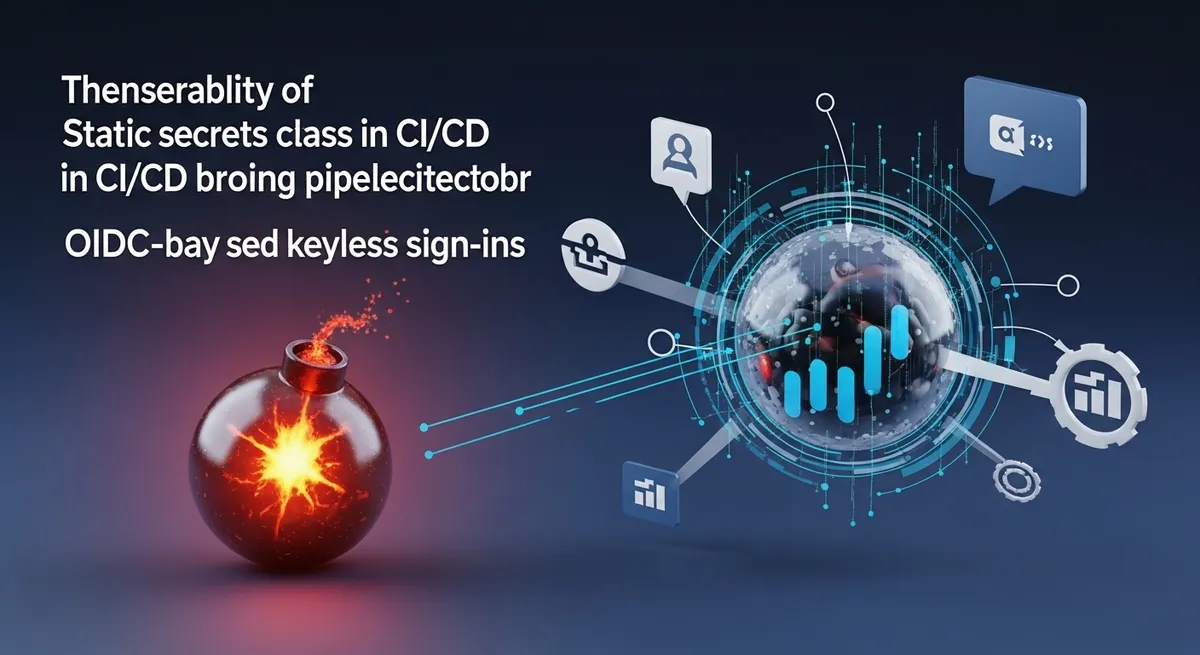
We have treated our CI/CD pipelines as credential lockers for too long. By storing static, long-lived secrets like AWS_ACCESS_KEY_ID and AZURE_CLIENT_SECRET in GitHub Actions or GitLab CI, we are creating a massive, static attack surface. If your CI/CD provider is breached, or if a malicious third-party action is introduced into your workflow, those keys are gone. It is time to treat our pipelines as identities, not buckets of secrets. The solution is OIDC keyless authentication.
What is OIDC Keyless Authentication?
OpenID Connect (OIDC) keyless authentication allows your CI/CD runner to prove its identity to your cloud provider (AWS, GCP, Azure) without needing a long-lived password or key stored in the environment. Instead of the runner saying, 'Here is a secret key that proves I am the admin,' it says, 'Here is a cryptographically signed token from GitHub that proves I am running the main branch of repo-x.'
This shift to Workload Identity Federation changes the game. When your workflow starts, the CI provider generates a short-lived JSON Web Token (JWT). Your cloud provider inspects this token, verifies it came from a trusted source (like GitHub or GitLab), and then issues a set of short-lived cloud credentials that expire the moment the job finishes. No keys to rotate. No secrets to leak. No permanent credentials sitting in a database waiting for a hacker to find them.
The Architecture of Zero-Secret Trust
Implementing OIDC moves us toward a 'Zero-Secret' architecture. Here is how the handshake actually works in the wild:
- The Request: Your CI runner requests an OIDC token from the provider.
- The Token: The provider (e.g., GitHub) mints a JWT containing 'claims'—metadata about the job, such as the repository name, the actor, and the specific git ref.
- The Exchange: The runner sends this JWT to the Cloud IAM service.
- The Validation: The cloud provider checks the signature and ensures the claims match a pre-configured trust policy.
- The Result: If everything checks out, the cloud provider returns temporary credentials (STS tokens in AWS) for the duration of the job.
As noted by GitLab's documentation on ID tokens, this standardized approach is rapidly replacing older, less secure JWT methods because it provides a scalable, least-privilege model for cloud access that doesn't rely on humans manually managing sensitive strings.
Granular Claims: The Real Security Powerhouse
One of the biggest GitHub Actions security best practices is moving beyond simple 'all-or-nothing' access. With static keys, a secret is a secret; once a process has it, it can do anything those keys allow. With OIDC keyless authentication, you can use 'claims' to get incredibly granular. You can write a trust policy in AWS or GCP that says: 'Only allow this role to be assumed if the token comes from the production environment and was triggered by a tag push.'
This prevents a developer from spinning up a 'test' branch and using the CI pipeline to exfiltrate production data. You aren't just authenticating a platform; you are authenticating a specific context within that platform.
The Nuance: OIDC is Not a Silver Bullet
While I am a massive advocate for this transition, we have to talk about the 'False Sense of Security' trap. Moving to OIDC doesn't eliminate risk; it shifts it. Instead of managing secrets, you are now managing trust policies. A common mistake is creating a trust policy that is too broad—for example, trusting any repository within your organization to assume a production role.
A report from Unit 42 highlighted that OIDC misconfigurations can be just as dangerous as leaked keys. If your 'subject' claim (sub) isn't properly restricted to specific repositories or branches, an attacker could potentially use a malicious repo in your organization to impersonate a legitimate one. Security isn't 'set and forget'; it's 'verify and scope.'
Addressing Setup Complexity
I often hear DevOps teams complain that OIDC is 'too much work' compared to just pasting an API key. Yes, the initial handshake involves setting up an OIDC Provider in your cloud IAM and writing a trust policy. It takes 30 minutes instead of 30 seconds. But compare that to the hundreds of hours spent on incident response, rotating keys after a developer's laptop is stolen, or explaining a breach to your CTO. The 'complexity' argument is a debt you pay now to avoid a catastrophic interest rate later.
Beyond Auth: Keyless Artifact Signing
The beauty of OIDC keyless authentication is that it extends to the entire software supply chain. Once your pipeline has a trusted identity, you can use tools like Sigstore and Cosign to sign your container images or binaries without ever touching a private GPG key. The OIDC token acts as the proof of identity for the signature. This ensures that the image running in your production Kubernetes cluster was actually built by your trusted pipeline and hasn't been tampered with by a man-in-the-middle.
Conclusion: Make the Pivot Today
The era of static credentials in CI/CD is ending. With supply chain attacks doubling year-over-year, we can no longer afford to leave 39 million secrets lying around for attackers to find. By implementing OIDC keyless authentication, you eliminate the risk of long-lived credential theft, enforce granular access control via claims, and significantly reduce your attack surface.
Start small: pick one non-critical pipeline, set up Workload Identity Federation in your cloud of choice, and delete those static secrets. Once you experience a pipeline that 'just works' without a single password in the settings panel, you will never want to go back. Secure your identity, and the secrets will take care of themselves.