The Distributed Tracing Trap
I recently watched a lead DevOps engineer spend three days trying to map a single RAG (Retrieval-Augmented Generation) failure using standard Jaeger spans. By the end of it, he had a beautiful waterfall chart that told him absolutely nothing about why the model hallucinated or which chunk of vector embeddings poisoned the prompt. We’ve spent a decade perfecting distributed tracing for microservices, but applying those same patterns to AI is like trying to use a map of the London Underground to navigate the open ocean. The coordinates exist, but the landmarks are all wrong.
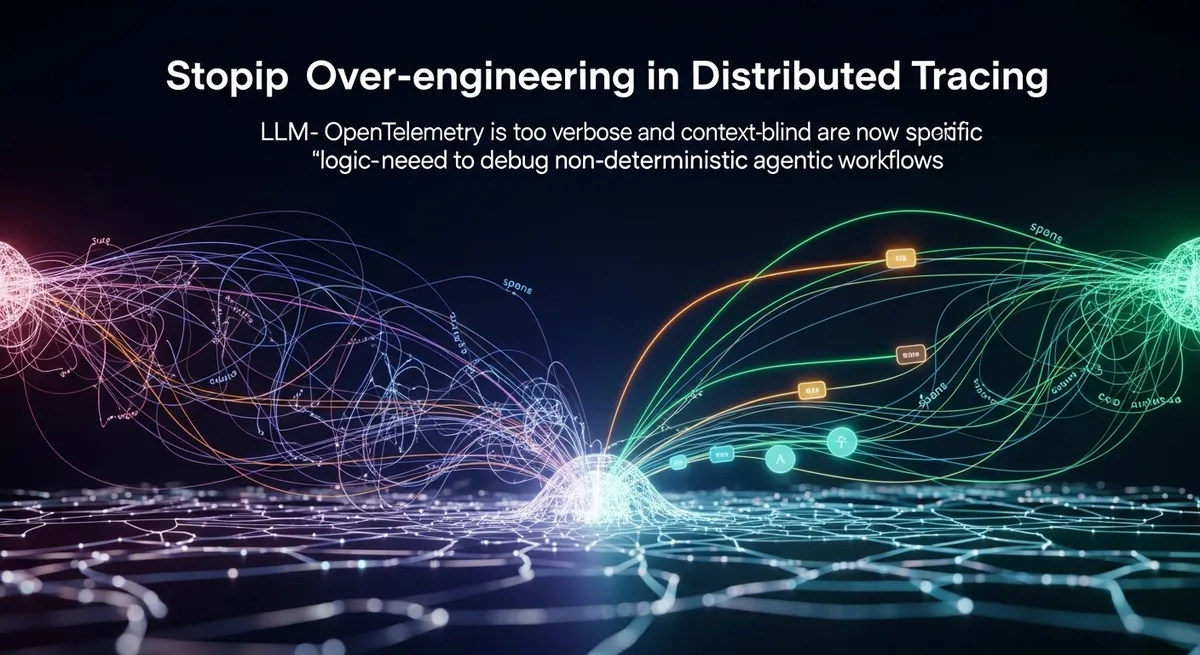
As we move from simple chatbot wrappers to complex agentic workflows, the 'standard' way of doing things is breaking. Traditional OpenTelemetry (OTel) is simply too verbose and context-blind for the non-deterministic nature of LLMs. This is where OpenLLMTelemetry enters the fray, promising to prune the noise and provide the specific span logic needed to actually debug an agent that's gone rogue.
Why Generic OpenTelemetry Fails the AI Test
Standard OpenTelemetry was designed for requests and responses where the logic is hardcoded. You know that if Service A calls Service B with a specific ID, you should get a specific JSON object back. In the world of LLM observability, the 'code' is natural language. The variables aren't just strings or integers; they are high-dimensional vectors and probabilistic tokens.
When you use vanilla OTel for an AI pipeline, you get a flood of spans that tell you the latency of an API call to OpenAI, but they lack the metadata that matters. You can't easily see the prompt template version, the retrieved context from your vector DB, or the token usage breakdown without a mountain of custom boilerplate code. You end up over-engineering a tracing system that provides 90% noise and 10% signal.
The Context Gap in Agentic Workflows
Tracing AI agents is particularly brutal because agents are iterative. An agent might loop five times before deciding on an answer. In a standard tracing tool, this looks like a repetitive mess of identical spans. You need to know which iteration failed and what the 'thought process' (the chain of thought) looked like at that exact millisecond. Generic tools don't respect the semantic hierarchy of an LLM call, treating a 4k token prompt the same way they treat a 1kb REST payload.
Enter OpenLLMTelemetry: Built for the Modern AI Stack
OpenLLMTelemetry is a set of open-source libraries designed to make your life easier by automatically instrumenting LLM providers and frameworks. Instead of manually creating spans for every LangChain call or LlamaIndex query, it does the heavy lifting for you. It’s built on top of the OpenTelemetry standard, so you aren't throwing away your existing infra—you're just giving it a much-needed brain transplant.
The brilliance of this approach is that it captures the 'LLM-native' attributes out of the box. We're talking about automatic logging of prompts, completions, tool calls, and even the nuances of temperature and top_p settings. It bridges the gap between the infrastructure layer and the intelligence layer.
Integrating with Arize Phoenix
One of the most compelling reasons to adopt this specialized tracing is the ecosystem surrounding it. For instance, tools like Arize Phoenix leverage OpenLLMTelemetry to provide a dedicated workbench for AI engineers. Instead of looking at a generic dashboard, you get a UI tailored for visualizing trace trees of agentic loops and evaluating the relevance of retrieved documents.
Shifting from Latency to 'Quality' Metrics
In traditional DevOps, the 'Golden Signals' are latency, errors, traffic, and saturation. In the world of LLM observability, we have to pivot. While latency still matters, 'quality' becomes a first-class citizen. Was the answer grounded in the source text? Did the agent follow the system prompt? Using OpenLLMTelemetry allows you to attach these 'evals' directly to your traces.
By standardizing how we collect these traces, we can start to automate the evaluation process. You can pipe your traces directly into an evaluation framework to run 'LLM-as-a-judge' tests. This is impossible if your tracing data is just a fragmented pile of logs and generic spans. You need the structured, LLM-aware data that OpenLLMTelemetry provides to make sense of the chaos.
How to Stop Over-Engineering Your Tracing
If you're currently building a production-grade AI app, stop trying to write custom wrappers for every OpenAI client call. Here is a better path forward:
- Adopt the OpenLLM Standard: Use instrumentations that are aware of the libraries you use, whether it's OpenAI, Anthropic, or Bedrock.
- Focus on Semantic Meaning: Instead of tracing every single function call, focus on tracing the flow of information—the prompt, the context, and the tool output.
- Use Specialized Visualizers: Don't force your AI team to use a tool built for SREs. Give them a view that shows the conversation flow and the retrieval metrics.
According to the documentation on OpenLLM standards, the goal is to create a common language for AI performance. By sticking to these conventions, you ensure that your stack remains modular. You can swap your backend vector DB or your LLM provider without having to rewrite your entire observability layer.
The Future is LLM-Native
We are moving away from the era of 'black box' AI development. The move toward OpenLLMTelemetry represents a maturity shift in the industry. We are acknowledging that AI applications are a different breed of software that requires a different breed of monitoring. We don't need more spans; we need better ones.
The era of over-engineering custom logging for every prompt is over. By adopting a specialized, LLM-native approach, you can spend less time fighting your telemetry and more time refining the prompts and models that actually drive value. If you haven't yet, take a look at your current tracing stack. If you can't see the 'why' behind an agent's failure in less than sixty seconds, it's time to upgrade your observability game.
Ready to fix your traces? Start by integrating OpenLLMTelemetry into your dev environment today and see the difference that LLM-native context makes. Your future self, debugging a 3:00 AM production failure, will thank you.