The Shift to Agentic AI: From Prompting to Autonomous Execution
Why the future of AI is not about asking better questions — but delegating entire workflows.
Over the past few years, Generative AI has fundamentally changed how we interact with software. Developers, marketers, and founders learned the art of prompt engineering — crafting inputs to extract high-quality outputs from models.
But as we enter 2026, a deeper shift is underway.
The paradigm is changing:
We are moving from AI that responds → to AI that executes.
We are moving from AI that responds → to AI that executes.
This new class of systems — often referred to as Agentic AI — represents the next evolution: systems that don't just generate answers, but take actions, make decisions, and complete tasks end-to-end.
What Exactly is an AI Agent?
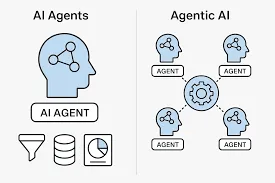
An AI Agent is a system that uses a Large Language Model (LLM) as its reasoning core, but extends beyond text generation by integrating:
- Execution capabilities (APIs, tools, environments)
- State management (memory and context)
- Planning and iterative reasoning loops
Unlike traditional chatbots that operate in a single request-response cycle, agents operate in multi-step feedback loops, continuously observing, reasoning, and acting.
Example:
A chatbot might tell you how to book a flight.
An AI Agent will:
A chatbot might tell you how to book a flight.
An AI Agent will:
- Search flights based on your preferences
- Check your calendar for conflicts
- Compare prices across platforms
- Log into your account
- Complete the booking
- Send confirmation + calendar invite
The Research Behind Agentic AI
The rise of agentic systems is not accidental — it is backed by a wave of influential research:
- ReAct (Reason + Act, 2023): Introduced the idea that LLMs perform better when they interleave reasoning with actions instead of purely generating answers.
- Toolformer (Meta): Demonstrated that models can learn when and how to use external tools.
- AutoGPT / BabyAGI: Early experimental frameworks showing autonomous goal-driven agents.
- Reflection & Self-Correction research: Models improve output quality by reviewing and refining their own work.
Key Insight:
Intelligence is not just about generating the right answer — it's about iterating toward the right outcome.
Intelligence is not just about generating the right answer — it's about iterating toward the right outcome.
The Three Pillars of Agentic Systems
1. Tool Use (Action Layer)
Agents extend beyond language by interacting with real-world systems:
- APIs (payments, email, weather, analytics)
- Developer tools (GitHub, CI/CD pipelines)
- Browsers (web navigation and scraping)
- Databases (querying and updating state)
This transforms LLMs from knowledge engines into execution engines.
2. Long-Term Memory
Traditional models are stateless. Agents introduce memory layers:
- Short-term memory: Context within a session
- Long-term memory: Persistent user preferences and history
- Vector databases: Semantic recall of past interactions
This allows agents to:
- Learn user behavior
- Avoid repeating mistakes
- Personalize decisions over time
3. Planning & Reasoning
Agents break down complex goals into smaller steps using structured reasoning approaches like:
- Chain-of-Thought prompting
- Tree-of-Thought reasoning
- Task decomposition + retry loops
Crucially, agents can:
- Detect failures
- Retry with alternative strategies
- Optimize toward a final goal
Think of it this way:
A chatbot is like a smart assistant.
An agent is like a junior employee that can execute tasks independently.
A chatbot is like a smart assistant.
An agent is like a junior employee that can execute tasks independently.
Why This Matters for Developers & Businesses
Agentic AI is not just a technical upgrade — it is a business model shift.
1. Automation of Knowledge Work
Tasks previously requiring human coordination can now be automated:
- Customer support workflows
- Sales outreach + follow-ups
- Data analysis and reporting
2. Self-Healing Systems
Imagine infrastructure that maintains itself:
- Detects bugs
- Writes fixes
- Runs tests
- Deploys updates
This is already emerging in AI-driven DevOps pipelines.
3. Productivity Multiplication
Instead of one person doing one task, a single developer can now:
- Manage multiple agents
- Delegate parallel workflows
- Focus only on high-level decision making
The New Skill Shift:
The most valuable skill is no longer writing prompts —
it is designing systems of delegation.
The most valuable skill is no longer writing prompts —
it is designing systems of delegation.
Challenges & Open Problems
Despite the promise, agentic systems are still evolving:
- Reliability: Agents can fail unpredictably in long chains
- Cost: Multi-step reasoning increases token usage
- Security: Autonomous actions introduce risk
- Alignment: Ensuring agents act within intended boundaries
Solving these challenges will define the next generation of AI infrastructure.
Final Thought
The era of asking AI "What should I do?" is ending.
The new question is:
"What can I delegate — and how do I design agents to execute it reliably?"
Those who master this shift will not just use AI — they will orchestrate it.