The $10,000 Latency Problem
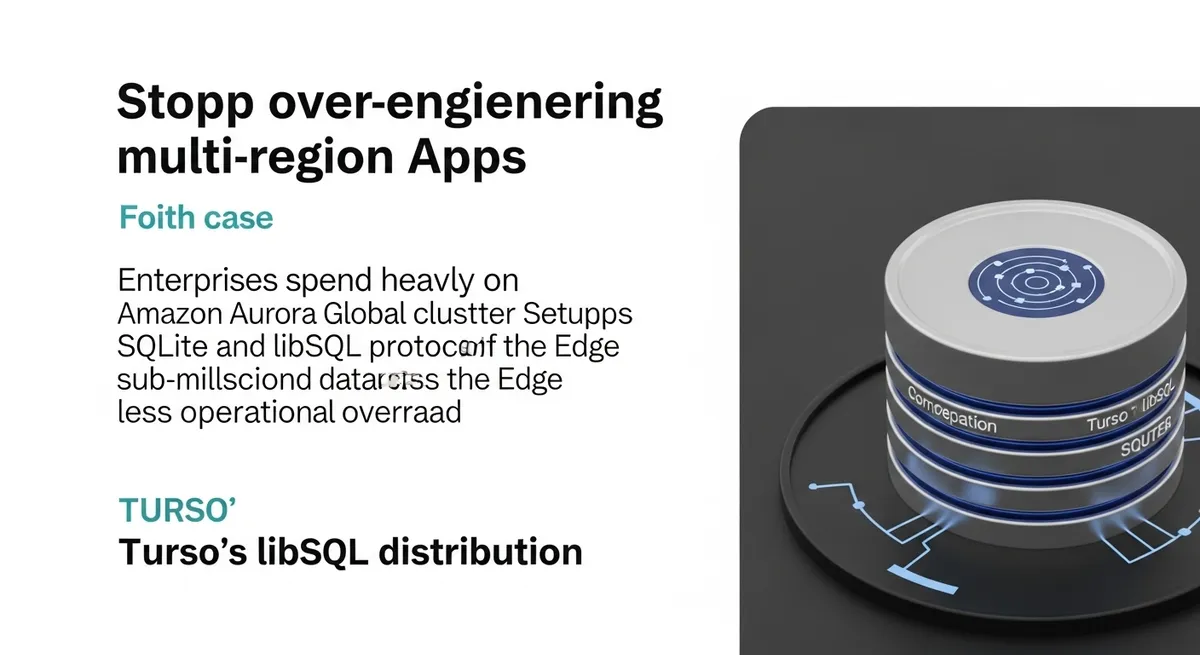
I recently watched a startup founder walk through their AWS bill. They were burning thousands of dollars a month on an Amazon Aurora Global cluster, convinced that a sophisticated multi-region database architecture was the only way to keep their application snappy for users in Singapore and London. The irony? Their app was mostly read-heavy dashboards. They were paying for a Ferrari to deliver groceries across the street. We have been conditioned to believe that global scale requires enterprise complexity, but Turso is proving that the humblest database in the world—SQLite—is actually the secret weapon for the modern edge.
The era of the 'Mega-Cluster' is facing a reckoning. As we move compute to the edge with Vercel or Cloudflare, we hit a wall called Data Gravity. Your serverless function might start in 10ms, but if it has to reach across the Atlantic to fetch a user profile from a regional silo, your p99 latency is toast. This is where Turso libSQL global replication changes the game by treating SQLite not as a local file, but as a globally distributed primitive.
Why SQLite is the Future of the Edge
For years, SQLite was relegated to mobile apps and side projects. The standard critique was simple: 'It doesn't scale' and 'It’s not network-aware.' Turso’s libSQL, an open-contribution fork of SQLite, solves both. By introducing a network-aware protocol and async I/O, Turso allows you to spin up a database that behaves like a cloud service while maintaining the zero-config joy of a local file.
But the real magic happens when you distribute it. Turso supports replication across 35+ global locations. Instead of your data sitting in a single us-east-1 bucket, it lives in the same data centers as your users. This isn't just marketing fluff; real-world benchmarks from teams like OpenStatus show that Turso can complete 5 serial queries globally in about 60ms, compared to 450ms for traditional regional databases. That is an order of magnitude improvement in edge database performance.
The Secret Sauce: Embedded Replicas and Turso Sync
If you really want to achieve 0ms read latency, you use Embedded Replicas. This feature allows you to sync a local SQLite file directly within your application environment. Your code reads from a local file on disk (blazing fast), while Turso handles the background synchronization with the primary database. It’s the ultimate architectural 'cheat code' for read-heavy applications.
The Evolution to Turso Sync
Recently, Turso announced a strategic shift in their 2025 roadmap. They are moving away from traditional physical page-based replication toward a new 'Turso Sync' architecture based on logical Change Data Capture (CDC). According to Turso, this new method is 7.3x faster and significantly more data-efficient. For developers, this means the 'missing middle'—apps that need global reach but don't have a Google-sized budget—just got a massive upgrade. They are even rewriting the core engine in Rust to support Multi-Version Concurrency Control (MVCC), which will eventually allow for concurrent writes, a traditional bottleneck for SQLite.
Simplifying Multi-Region Architecture
Most multi-region database architecture involves complex load balancers and manual read/write splitting logic. Turso simplifies this through a single connection URL. When your application connects, the Turso driver automatically routes queries to the nearest available replica. Writes are transparently forwarded to the primary region, while reads stay local. It’s the developer experience we were promised by the big cloud providers, but without the six-figure bill.
Database Branching: Git for Your Data
Beyond performance, Turso introduces workflow features that feel like magic. With Database Branching, you can fork your production database into a staging environment in seconds. This allows you to test schema migrations against real data without the risk of breaking production. For anyone who has spent a weekend sweating over a DROP TABLE command, this is a literal lifesaver.
The Trade-offs: Speed of Light Still Matters
Let’s be real: Turso isn't a silver bullet for every use case. Because it uses a primary-replica model, writes still face 'speed of light' latency. If your app is incredibly write-heavy—think a high-frequency trading platform or a massive real-time chat app—routing every write back to a single primary region might be a bottleneck. However, for 90% of SaaS applications, the trade-off of slightly slower writes for lightning-fast, globally distributed reads is a no-brainer.
There has also been some community discussion regarding the 'Open Contribution' nature of libSQL. While the core engine is open, the server-side control plane that manages the global fleet is proprietary. For most, this isn't a dealbreaker, but it’s a nuance worth noting for those committed to 100% open-source stacks.
The Disruptive Free Tier
One of the most compelling reasons to choose SQLite for production via Turso is the price. Their free tier is notoriously generous, offering up to 500 individual database instances. This makes it an incredible choice for multi-tenant SaaS providers. You can give every single customer their own isolated database, keeping data siloed and secure without incurring massive overhead. It’s a total departure from the 'one giant multi-tenant table' approach that has plagued database design for decades.
The Final Verdict
Stop over-engineering. You probably don't need a globally distributed Spanner setup or an Aurora Global cluster that costs more than your engineering team. By leveraging Turso libSQL global replication, you get the performance of the edge with the simplicity of the most widely deployed database in history. You get to ship faster, pay less, and—most importantly—provide a better experience for your users regardless of where they are on the planet.
Ready to kill the latency? Start by moving your read-heavy workloads to a Turso embedded replica and see the difference for yourself. Your users (and your CFO) will thank you.